By Kate Rouhana
In this interview,1 Kate Rouhana, the founding director of Jerusalem Story,2 sheds light on the website and its mission.
Q: What is Jerusalem Story?
K.R.: Jerusalem Story is an English-language website launched under the auspices of the Arab Center for Research and Policy Studies3 that aims to tell the story of a unique city through a seldom-used lens – that of the city’s large and diverse Palestinian community. This community, which makes up nearly half of the city’s population, has deep historic roots in Jerusalem and holds the strongest attachment to and love for their city. Yet, they have been subjected to unrelenting efforts to erase their presence in, and potential claim to, the city – past, present, and future – to cement Israel’s claim of sole sovereignty over a “united Jewish Jerusalem.” These efforts, targeted through an overriding demographic imperative to maintain a Jewish majority to ensure control over the city, started decades ago and have taken myriad highly destructive forms, continuing to the present day, as is openly acknowledged by Israeli officials and decision-makers, and as our work amply documents.
Q: Why focus on Jerusalem and its people?
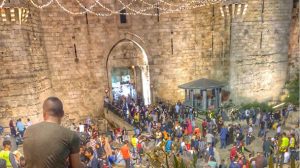
K.R.: Jerusalem is holy to billions of Muslims, Christians, and Jews around the world. It’s a cherished world heritage site that should be open and available to all. Today, however, although Jerusalem is known as the “holy city” or the “city of peace,” the reality on the ground is starkly, darkly different.
To understand what’s happening in Jerusalem today, a little history: Jerusalem was conquered by force by Israel in two stages, in 1948 and in 1967. In the first stage, involving 84 percent of the city’s area, almost all of the 75,000 Palestinian residents living there and in the 40 or so surrounding Arab villages were ethnically cleansed by Zionist forces pre-1948 and the Israeli army after that.4 Although Jerusalem had been designated for international status in the UN’s 1947 Partition Plan for Palestine, Israel seized this area, incorporated it into its state, and rapidly passed laws stripping the Palestinian population of citizenship and making them stateless refugees, seizing all Arab property and assets, and banning their return. The city was thus emptied of one population and divided.5 Israel renamed this part of the city “West Jerusalem.” Many refugees ended up in the remaining 11 or so percent of the city, which Jordan annexed for the next 19 years and which became Arab Jerusalem.6
In 1967, Israel occupied the rest of the city, defeating Jordan, and illegally imposed its laws in violation of international law. It also tripled the size of the newly occupied area, which it renamed East Jerusalem, unilaterally enveloping 28 Palestinian villages.7 A rushed census found that although tens of thousands had been displaced out of the city, the newly occupied area still had nearly 66,000 Palestinians.8 This was enough to radically alter the city’s demographic balance overnight: from 1 percent Palestinian in West Jerusalem before the 1967 War to 26 percent Palestinian in West + East Jerusalem after it.9 For the state, this posed an increasing existential threat: the possibility of losing control of the city if its Palestinians became a majority. From this point on, planning and policy decisions in Jerusalem were driven by an officially determined demographic imperative: to keep the Palestinian population contained at 26.5 percent or less.10
Jerusalem Story features a website that comprises a variety of sections, including The Big Picture, 16 Topics that fall under 6 Themes, a Jerusalem Notebook, Biographies, Quick Facts, a Lexicon with definitions, and a database of Palestinian Organizations active in the city. It also gives access to several short documentary films.
Today, Palestinians make up at least 40 percent of Jerusalem’s residents; mostly likely closer to 50 percent. Of those, 99 percent live in East Jerusalem, where they comprise at least 61 percent of the residents.11 This data alarms Israeli city and state officials. They openly declare their intent to Judaize Jerusalem and maintain all of it under permanent Israeli control. In their eyes, the two most essential requirements for achieving this goal are maintaining a Jewish demographic majority and building settlements for Jews to seize and keep the land.
Hence, Jerusalem is a city whose officials are openly committed to removing as many of the native Palestinians – who had lived in the city for centuries before Israel was founded and were citizens before 1948 – by any and all means possible. Those who remain should be subjugated and Israelicized, rendered docile and compliant within a state defined as exclusively for the Jews where others have no rights or political power and should not expect to get any.
Urban planning thus becomes a clear and explicit matter of causing one community (Jews) to thrive and flourish, while another (Palestinians) is continually controlled, surveilled, presumed to be hostile, and sent the unmistakable message that they are unwelcome interlopers – with every bureaucratic procedure, even the most mundane. Need to renew your driver’s license? Prove to the Ministry of Interior that your “center of life” has been in Israel for the past seven years. Can’t prove it with the copious documentation required? Sorry, your legal status is revoked and you must leave the city immediately.
In its relentless and ongoing attempts at removal and erasure of Palestinians, on the one hand, and total dominance for Jews, on the other, Israel has targeted the Palestinian community’s institutions, its leadership, its economy, its societal fabric, its educational system, its language, its history, its culture, its cemeteries, and much more. Anything that supports a potential Palestinian national claim to the city – past, present, or future – is ferociously targeted and often criminalized. And yet despite these immense hardships, the vast majority of Palestinian Jerusalemites go to unimaginable lengths to remain in Jerusalem, because their rootedness in their city is so deep and fundamental.
Jerusalem Story aims to shine a light on these dystopian realities, and, in so doing, to bear witness and attempt to restore an extremely endangered community back into its own story. We also center the community’s lived realities in and contributions to their beloved city as a counterpoint to Israeli efforts to invisibilize and erase them. In the wake of Israel’s genocidal assault on Gaza, and its emptying of swaths of the West Bank in recent months, Jerusalem’s Palestinians are gravely imperiled.
Q: What does Jerusalem Story offer to its audience?
K.R.: Jerusalem Story offers in-depth research, analysis, and coverage of the story of the Palestinian community of Jerusalem, its past, present, and future. The site has a mix of research and more journalistic and personal features, so viewers can read both side by side: comprehensive, dispassionate facts alongside personal stories, interviews, case studies, and visuals that help bring those facts alive. Likewise, the site takes a multimedia approach, almost like an online museum, and offers print, stunning photos (including photo essays and photo albums), graphics, illustrations, videos, and interactive maps.
The site has a variety of sections. The first is called The Big Picture, which is the website’s starting point. In an animated display of powerful images overlaid with narrative text, The Big Picture pulls all the key points of our Jerusalem Story into one introductory-highlights presentation.
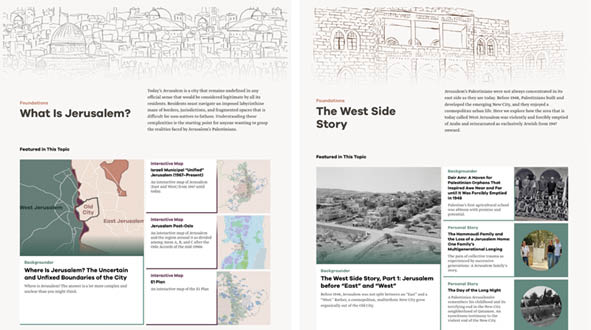
The next section comprises Themes and Topics, where content is organized around a specific key topic, such as What Is Jerusalem?, Who Are the Palestinians in Jerusalem?, The West Side Story, Precarious Status, Land, and more. Each Topic has its own landing page and menu for easy access. To date, we have launched 16 Topics, which you will find grouped under 6 Themes on the Main Menu of our website.
Within these Topics, one type of work to highlight here is personal family histories, memoirs, and profiles. We help families compile their materials into original memoirs, stories, and albums. In addition to the family histories that we develop, we also curate and republish others’ published memoirs. Bringing them together side by side with our other materials and bios can create powerful cross-connections and synergies. For example, a personal memoir about the end of the Palestinian neighborhood of Qatamon, written decades ago while the experience was still fresh, read alongside a research backgrounder about the ethnic cleansing of Jerusalem in 1948, helps bring the history alive.
In addition to the work on family stories, we also search high and low for historic photos and develop unique photo-focused content out of them; for example, we feature a photo essay about the YMCA as a social and cultural hub before 1948, another photo essay about the King David Hotel and its bombing by Zionist forces in 1948, a photo album of pre-Nakba original works by Palestinian photographer Khalil Raad, a photo album of historic photos about the Armenians of Jerusalem, and a photo album about the life of Hind al-Husseini. As well, we try to curate collections of art by Jerusalemite artists within Photo Albums and bios (e.g., Jumana El Husseini, Samia Halaby, Kamal Boullata).
Next is Jerusalem Notebook, our blog. In it, we feature all manner of stories about the Palestinian community of Jerusalem – from character or organizational profiles to interviews to historical sketches of landmarks and traditions, book reviews, reviews of local exhibits and shows, personal perspectives, and more. Blog posts are sorted by categories for ease of access (e.g., Books, Exhibits, Profiles, Food, Film, etc.).
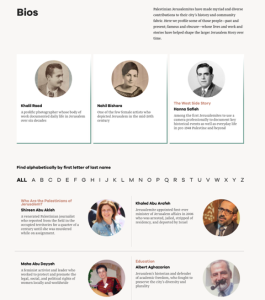
We also have a Biographies section. Here we profile Palestinian Jerusalemites – past and present, famous and obscure – whose lives and stories have helped shape the larger Jerusalem Story – and the story of their community within it – over time. The bios can be of people who are either alive or deceased. We aim to profile both the very famous alongside the not-so-well-known unsung heroes. We also aim for diversity in all respects, trying to profile people from all walks of life. Their common denominator is that Jerusalem was central to their life, or they made a long-lasting contribution to the community’s fabric of life. Over time, we find that the bios start to connect with one another and weave a fabric, recreating or reconstituting a society and its collective life at various points in history. We are always open to suggestions from the public for new biographies.
Our Quick Facts section is a large set of FAQs about the Jerusalem Story. Where relevant, each Quick Fact is linked to a website Topic.
Our Lexicon offers clear and helpful definitions of the many terms that are unique in this arena, given its rootedness in many languages, as well as the legal, military, and technical jargon that has emerged over the decades of military occupation. Recently the authors of a review in The Heritage, Memory and Conflict Journal described this work as follows: “In their aim to re-tell and re-shape the narrative of a contested place, Jerusalem Story offers a remarkable Lexicon of the terminology, words, names of places, memories, and their meanings that are used to describe Jerusalem’s places, stories, and history. This significant part of participatory practices to heritage management reveals the power of words that have ‘nuanced shades of meanings’ in creating and promoting narratives of complex places in conflict zones.”12
Finally, we have compiled a database of Palestinian organizations on the ground that work on Jerusalem. This effort is important insofar as the Israeli authorities have made massive efforts over the decades to decapacitate this community by closing down its institutions, and the ones that remain face myriad challenges. Our database makes them and their work more accessible to users worldwide.
In addition, Jerusalem Story has produced a number of short films, some of which are available on the website, while others can be accessed on YouTube and Instagram.13 For example, there is a documentary about the attempted takeover of the historic Khalidi Library in the Old City by settlers using forged documents. Another documentary presents Dar Al-Tifel Al-Arabi, the institution founded by Hind al-Husseini when she found orphans from the Deir Yassin massacre lost and alone by the Church of the Holy Sepulcher in 1948. A documentary about Kufr ‘Aqab shows the densely populated Palestinian neighborhood that is located beyond the Separation Wall but within the Israeli municipal boundaries, which the municipality has openly abandoned for over a decade and which the state wishes to excise from the city. Another documentary deals with a kindergarten in al-‘Izariyya that has to operate in the shadow of the Separation Wall, which was built literally on the edge of its school playground.
Q: How is Jerusalem Story different from other mainstream media initiatives that cover Jerusalem?
K.R.: The mainstream media uncritically accepts the Israeli hegemonic narrative about Jerusalem, which views the entire city as a Jewish one that will belong solely to Israel in perpetuity. As for the native Palestinians, they are depicted as “aliens” who apparently just arrived in 1967 when Israel occupied the east side of the city. Israel does its best to erase the unpalatable history of how West Jerusalem came to be exclusively Jewish and integrated into the State of Israel. This produces analyses and reporting that whitewash and erase the vital history of one half of the city’s population. Jerusalem Story aims to report on the city as it really evolved over recent history and as it truly is today, integrating the lived realities and voices of the hundreds of thousands of Palestinians whose ancestors built and cherished their city and whose roots in it and rights to it should be, in any normal city, a matter of pride and honor, not a target for criminalization and erasure. It also shines a spotlight on the persistent and aggressive Judaization of a city that is holy to many religions – a world treasure.
1 Jerusalem Story.
2 Jerusalem Story.
3 Rouhana, “Jerusalem Should Be Open and Available to All.”
4 Jerusalem Story, “The West Side Story.”
5 “The West Side Story.”
6 “The West Side Story.”
7 Jerusalem Story, “What Is Jerusalem?.”
8 Joel Perlmann, “Introduction to Volume 6,” in The 1967 Census of the West Bank and Gaza Strip: A Digitized Version (Annandale-on-Hudson, NY: Levy Economics Institute of Bard College, November 2011–February 201), xi [digitized from Israel Central Bureau of Statistics, “Census of Population and Housing, 1967 Conducted in the Areas Administered by the IDF,” vols. 1–5 (1967–70), and “Census of Population and Housing: East Jerusalem, Parts 1 and 2” (1968–70)].
9 Michal Korach and Maya Chosen, Jerusalem Facts and Trends 2021: The State of the City and Changing Trends (Jerusalem: Jerusalem Institute for Policy Research, 2021), 17.
10 Inter-Ministerial Committee to Examine the Rate of Development for Jerusalem, Recommendation for a Coordinated and Consolidated Rate of Development, Jerusalem, August 1973, 3 (Hebrew).
11 Omer Yaniv, Netta Haddad, and Yair Assaf-Shapira, Jerusalem Facts and Trends 2023: The State of the City and Changing Trends (Jerusalem: Jerusalem Institute for Policy Research, 2023), 112–15.
12 Nour Allah Munawar and Issam Nassar, “Decolonizing the Sacred: The Politics of Heritage in Jerusalem,” Heritage, Memory and Conflict Journal 5(1), May 2025, 1–22.
13 You can view these and more on the Jerusalem Story website (www.jerusalemstory.com) and YouTube channel
(@Jerusalemstory), as well as hundreds of reels on Jerusalem Story’s Instagram (@jerusalem_story).