


By Sarah Zahran
How does a child see the world – and how is the world carried to them in return? These are not simple questions. They have long shaped the field of childhood studies and guided attempts to understand a realm that is formed through imagination and play, curiosity and discovery, imitation and invention. As children live in a world where learning unfolds through both personal experience and collective interaction, these questions also open onto something more: a space dense with possibility. A world that does not merely resist darkness but actively produces new forms of healing and survival. Its strength lies in its ability to generate joy, to inhabit it, and to circulate it even within complex and fractured realities. Within this world, children are not passive recipients of experience. They are active agents – shaping meaning, affirming life, and contributing to the very conditions that sustain it.
Much of Palestinian art is entangled with the world of childhood, with children frequently depicted as symbols of survival and strength. These representations at the Palestinian Museum shape the experiences of both children and adult visitors. Drawing on images, posters, and paintings from the Palestinian Museum’s exhibitions, collections, and digital archive, this visual journey moves beyond analysis to open deeper questions about art: its ability to generate cultural and aesthetic experience, to reflect a world full of life, and to imagine pathways of survival.
In these works, the child emerges as an active agent within culture, articulating strength, courage, and endurance. These representations do not simply mirror reality; they draw on artistic expression to shape a social imagination that resists dominant narratives. Instead of positioning children solely as victims, figures in need of constant care, education, and protection, or as sources of fear and anxiety for adults, this perspective reclaims their presence through the language of art. It foregrounds the forms of strength that emerge through artistic representations, where childhood becomes a site of metaphor, rooted in lived experiences across the history of Palestinian art. In this sense, children are not merely subjects of depiction, but partners in the production of meaning and carriers of the story, of our story in Palestine.
Strong children. At first glance, the phrase may seem almost fictional when set against the lived realities of children in Palestine, or within imaginaries that actively strip them of their childhood and all that it entails. Yet, if we approach childhood as a methodological lens for historical analysis, a more layered picture begins to emerge. Across time, representations of children in art have shifted with changing social and political contexts, moving from symbols of innocence and redemption in the eighteenth century to figures of vulnerability and care in the twentieth, shaped largely by critiques of industrialization and child labor. In liberation contexts such as Latin America and South Africa, this trajectory expands: Children appear not only as victims and witnesses to war and injustice, but also as political actors and carriers of collective memory, embodying both history and the possibility of a future.
Contemporary understandings of childhood, informed by theorists such as Jean Piaget and Lev Vygotsky, further reposition the child as an active producer of meaning. Within this broader arc, Palestinian art offers a complex articulation where play intersects with danger, imagination with reality, and life with survival. Here, the child is not confined to vulnerability, but emerges as an active subject capable of imagining, confronting, and producing meaning at once. This is not an escape from reality, but a way of enduring it.
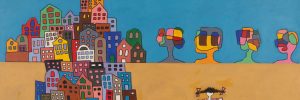
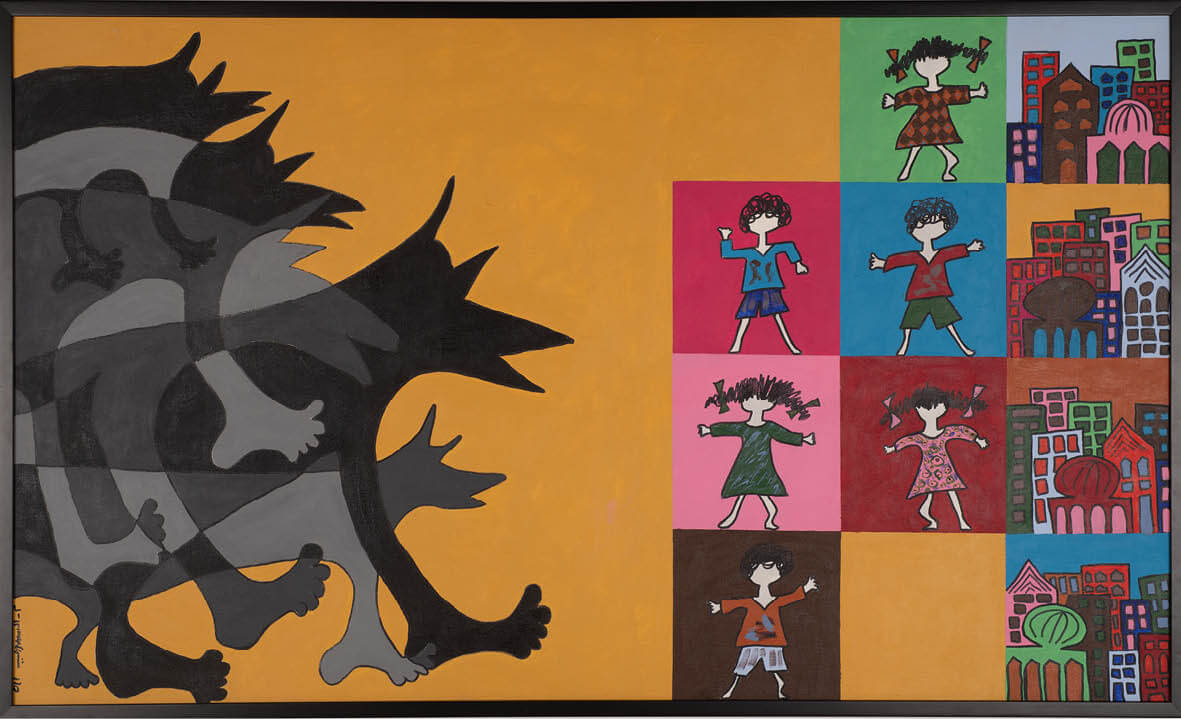
In the works of Mohammad Al-Samhouri, presented in This Is Not an Exhibition, children appear in closely packed spaces, adjacent homes pressed against one another, yet they share an enduring ability to celebrate life through dance and play, even as the city around them is being devoured. They are not depicted as easy prey. Instead, their immersion in childhood becomes a pathway to survival.
As Piaget suggests, children possess the capacity to reconstruct reality, not merely receive it. They build their worlds through symbolic spaces that reflect an ability to reinterpret and reimagine what surrounds them. In another of Al-Samhouri’s works, children sing and dance outside, beyond the confines of walls, perhaps as a metaphor for the expansiveness of life and its openness to possibility through the eyes of a child.
As we explore an expanded concept of childhood, we inquire how art constructs the very notion of childhood. Is it shaped by time, defined by a fixed age, such as from infancy to eighteen? Or, in Palestine, is it determined by experience? In this sense, time loosens the relationship between the concept of childhood and its representations, allowing it to be redefined through the contexts in which experience is formed.
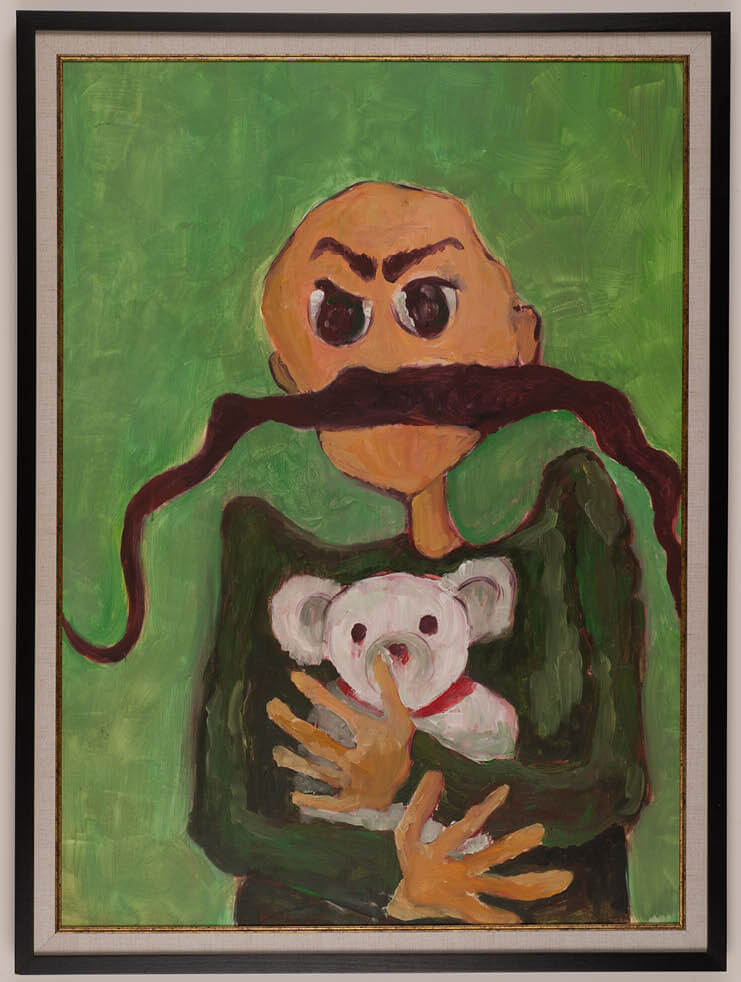
This approach is articulated by Majdal Nateel in her painting The Last of Men, where childhood is paradoxically completed through a leap beyond it. Children assume the roles of adults in acts of endurance and survival, inhabiting positions that exceed their age. Here, art does not present children simply as children, as figures of innocence, softness, and curiosity. Rather, it reimagines them within a more complex terrain, where childhood is reconfigured in response to lived realities.
In the museum’s exhibition, visiting children stood for long times, lifting their heads to look at Majdal Nateel’s The Last of Men. They laughed at the man holding a toy, with his very long mustache exaggerated yet strangely weightless. The figure appeared delicate, afraid, clutching a doll. “Perhaps he is mad,” some of them said. They did not speak of the children who had grown far too quickly over the most recent two years of war on Gaza. Of those who had left behind their toys and homes, some displaced more than ten times across the geography of Gaza, a landscape that has consumed their ability to play, to move, to live. Nor did they speak of an occupation that sees in them the future, judging them across time, not for who they are now, but for what they might become.
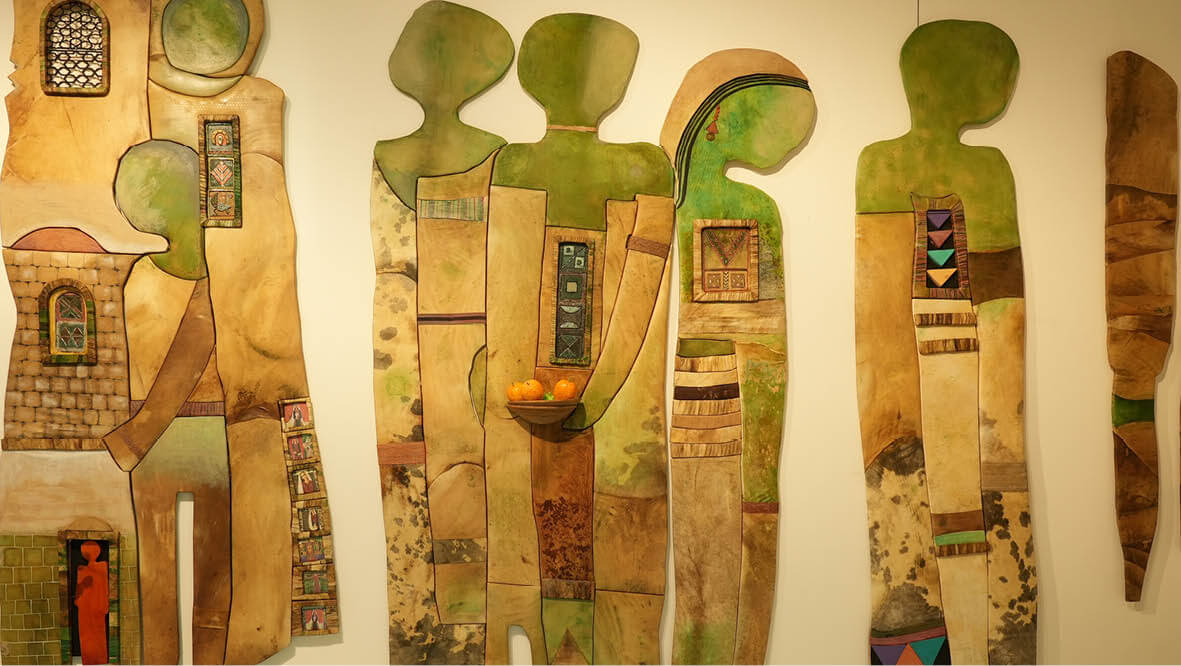
Children also appear as carriers of memory. Mona Saudi’s workshops with children, titled “In Time of War: Children Testify,” were conceived not only as a method of release or catharsis but also as an act of recording, of documenting the story from the children’s own perspective. In Saudi’s own work, children appear larger than occupation, rising above missiles, their role unfolding in balance with nature’s capacity to regenerate. They become an ongoing story, carrying Palestine in their hands, breathing gently onto pain so that it might heal.
In Palestinian art, children do not simply appear, they endure, imagine, and begin again. Between play and danger, loss and possibility, they carry fragments of life and reshape them into something that can still be held onto. In their gestures – whether they are raising a flag, drawing a house, or dreaming of flight – childhood becomes more than a stage of life; it becomes a language of survival, a quiet insistence on joy, and a way of imagining freedom, even when the world closes in.
This insistence on action is echoed in Nabil Anani’s The March of Trees, where a child carries a house – its stones and its stories. The house appears light, almost weightless, like an idea that cannot be destroyed or erased, but relocates wherever its bearer goes.
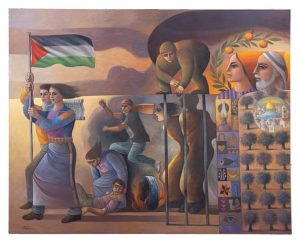
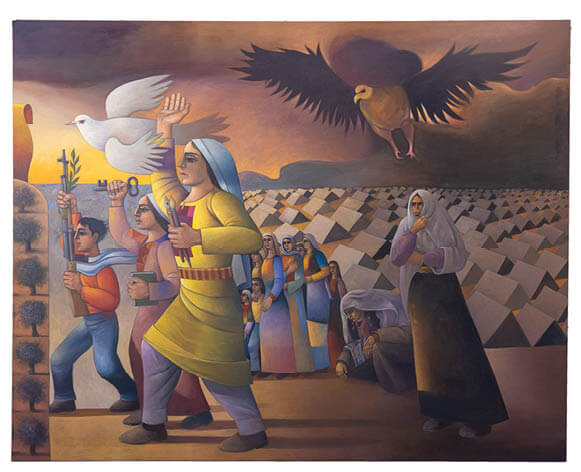
Similarly, in the enduring visual language of Sliman Mansour, which moves across generations, children and adults walk toward their homes in Jaffa and Haifa as active agents of the land, reading, resisting, struggling, tending olive groves, and carrying within them the symbols of Palestine and the embroidery of its thobes. It is a condensed symbolism that defines the Palestinian subject in relation to their enduring project of liberation.
Through the experience of imagination and play, the children in these works appear as experts, bearers of solutions that are capable of saving the world. Imagination deepens this expertise through visual narratives that resist constraint: Children leap over walls, cross barriers, and move across geographies without identity cards or permits.
In Hani Zurob’s Lesson in Aviation 1 (2009), the artist’s son Qudsi offers him ways to cross borders, moving from Gaza to Jerusalem, and then to the wider world. He asks him to climb onto his back so they can fly, or to ride a bicycle and pass through every red light. At its core, the child’s wish is simple: to visit his grandfather’s home, like any child in the world. Yet the painting reveals something far more complex. The visit is the subject, but the path toward it demands radical solutions, gestures that reach toward freedom through the act of flight.
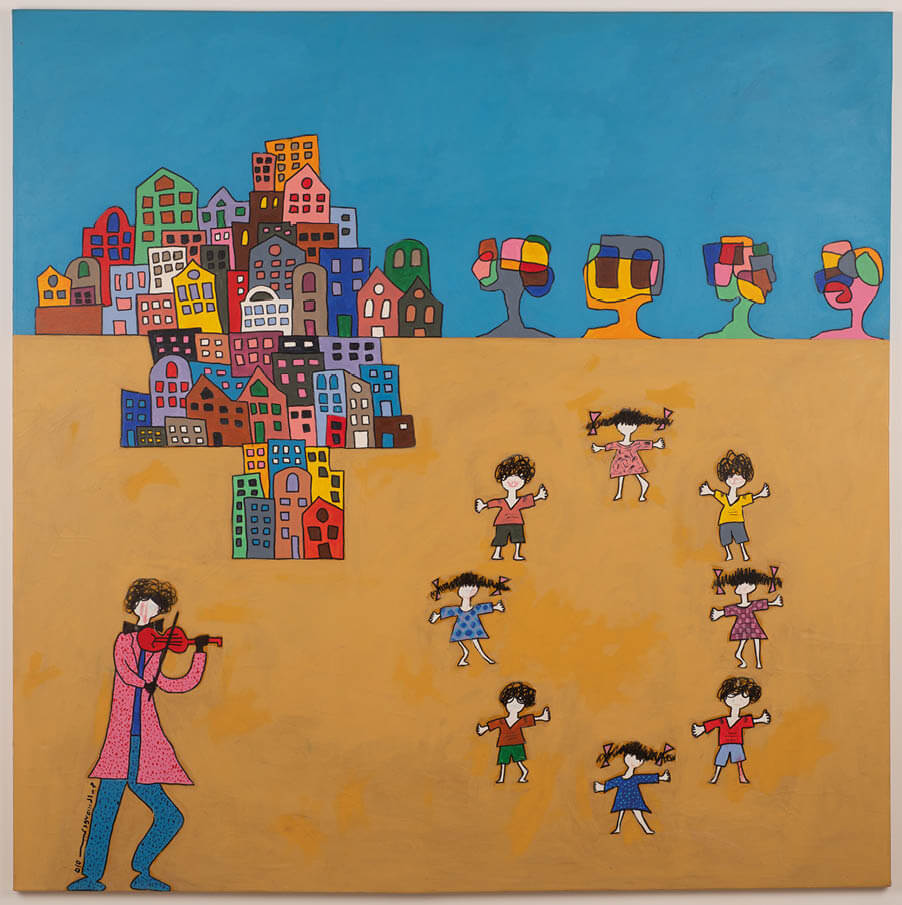
Al-Samhouri, Untitled; acrylic on canvas, 158 x 158 cm. Courtesy of the Mohammad
Al-Samhouri Collection.
In representations of survival, imagination offers extraordinary pathways, drawing its tools from the very fabric of reality. Children appear in their most familiar roles: riding bicycles, playing on swings, climbing walls and terraces, watching the stars. Yet beneath this apparent simplicity lies a deeper register: These gestures carry the weight of children’s dreams and their longing for freedom. Imagination works quietly but persistently, gathering strength, pulling toward that horizon, toward freedom.
Across paintings and posters, children carry the flag as a sign of victory, survival, and strength, one of the most powerful visual motifs produced by Palestinian art. In Mohammad Joha’s works, children raise the Palestinian flag in the face of death. The flag often wraps the bodies of victims of occupation violence, buried with them, yet this presence does not signify disappearance. Rather, it points to growth from beneath the earth a potent symbol of the future and an anticipation of freedom. In this sense, both the child and the flag emerge as central elements within these visual narratives, appearing in works made for children, as well as in those created by children themselves.
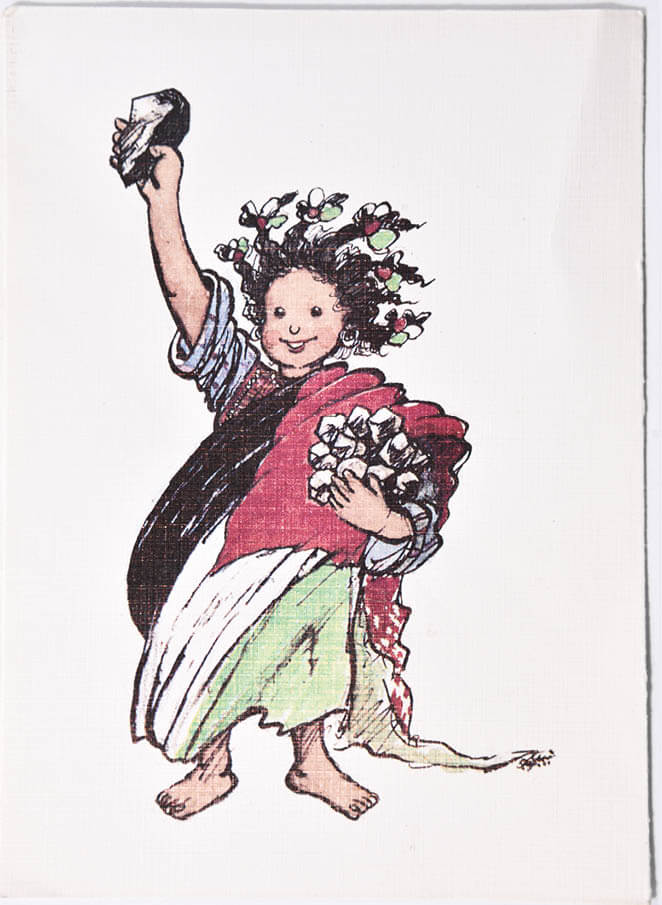
As the museum regularly offers workshops for and with children, the experience of working with them is grounded in multiple forms of engagement with art. Through these encounters, children explore exhibitions, contemplate artworks, ask questions, and develop ways of reading what they see, attuning themselves to the stories each work carries. These meanings take shape through their own modes of expression, as they begin to define concepts such as childhood, freedom, and war in their own terms. Even when death is present within the artworks, their readings consistently lead back to life, to a deeper rootedness in the land. Children respond to their environment and experiences by creating visual messages that pulse with life and hope, often inscribing them with the Palestinian flag and the textures of the land itself. It is as if they are part of an inevitable procession, one in which they stand as essential actors. They move forward as writers, artists, engineers, and fighters. They redefine the margins as sites of agency and transformation, carrying the future within them. In art, children emerge as strong, not only as representations of survival, but as a redefinition of life itself.
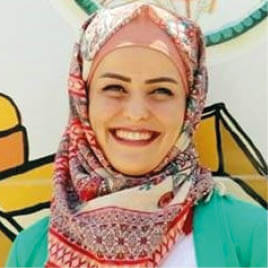
Sarah Zahran is a cultural researcher and education program officer at the Palestinian Museum. She holds a master’s degree in sociology with a focus on the intersections of culture and childhood. Sarah’s work approaches the world of children through writing, both about them and for them.

“This article romanticizes a tragedy. Defining childhood through the lens of ‘survival’ and ‘strength’ is an intellectual trap that justifies the theft of their innocence. These are not ‘strong children’ by choice; they are children being robbed of their right to be vulnerable, scared, and carefree. We should stop framing their trauma as an aesthetic form of art