


Courtesy of Al Mezan Center for Human Rights
For over 25 years, Al Mezan has documented and reported on violations against Palestinians in Gaza, bringing evidence of these crimes before the eyes of the international community. Our field researchers have documented every Israeli assault on Gaza between 2008 and 2021, the devastating impact of the blockade and closure unlawfully imposed on Gaza since 2007, the Great March of Return, and nearly every daily human rights violation committed against Palestinians, regardless of the perpetrator. Our lawyers have provided free legal aid to thousands of Palestinians facing grave human rights abuses, including hundreds of prisoners and detainees.
For over 75 years, the rights and freedoms of Palestinians have been violated in numerous and increasingly severe ways. As an organization made up almost entirely of Palestinian human rights defenders who are currently themselves enduring Israel’s genocide in Gaza, there is a highly personal and existential motivation to defend these rights and freedoms. Every human being deserves to live with dignity, and upholding international human rights is the cornerstone of this fundamental value.
Our staff members are especially proud of the tangible work we do that has positive effects on Palestinians in Gaza. The human rights defenders at Al Mezan take pride in providing legal services to Palestinians who have been arbitrarily detained. This work ranges from investigating cases of Palestinians who have disappeared or been arbitrarily detained, to helping their families determine the health and legal status of their loved ones, ensuring that their condition in detention centers is monitored, and pressuring Israeli forces to reduce or limit torture of detainees. Our staff members have also advocated for patient access to hospitals amid Israel’s continued violations of our right to freedom of movement. Being a Gaza-based organization, we also advocate for human rights violations to be investigated by local Gaza authorities. Al Mezan monitors the legislation and regulations that are part of the Israeli occupation. First and foremost, our human rights defenders document, report, and expose the reality of Israel’s brutal occupation of Palestinians and the international crimes being committed against us.

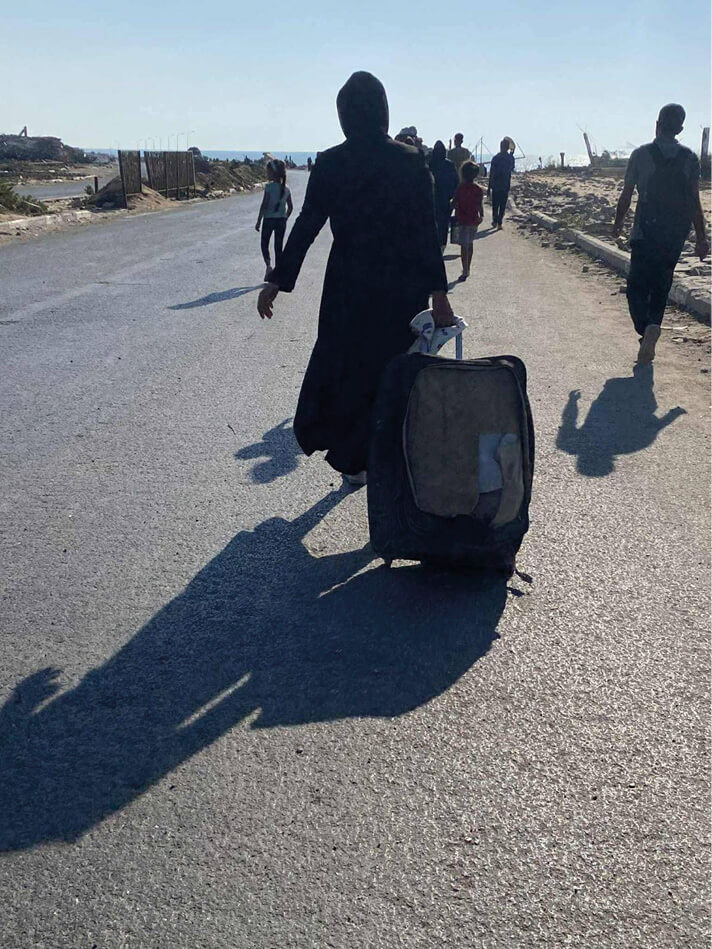
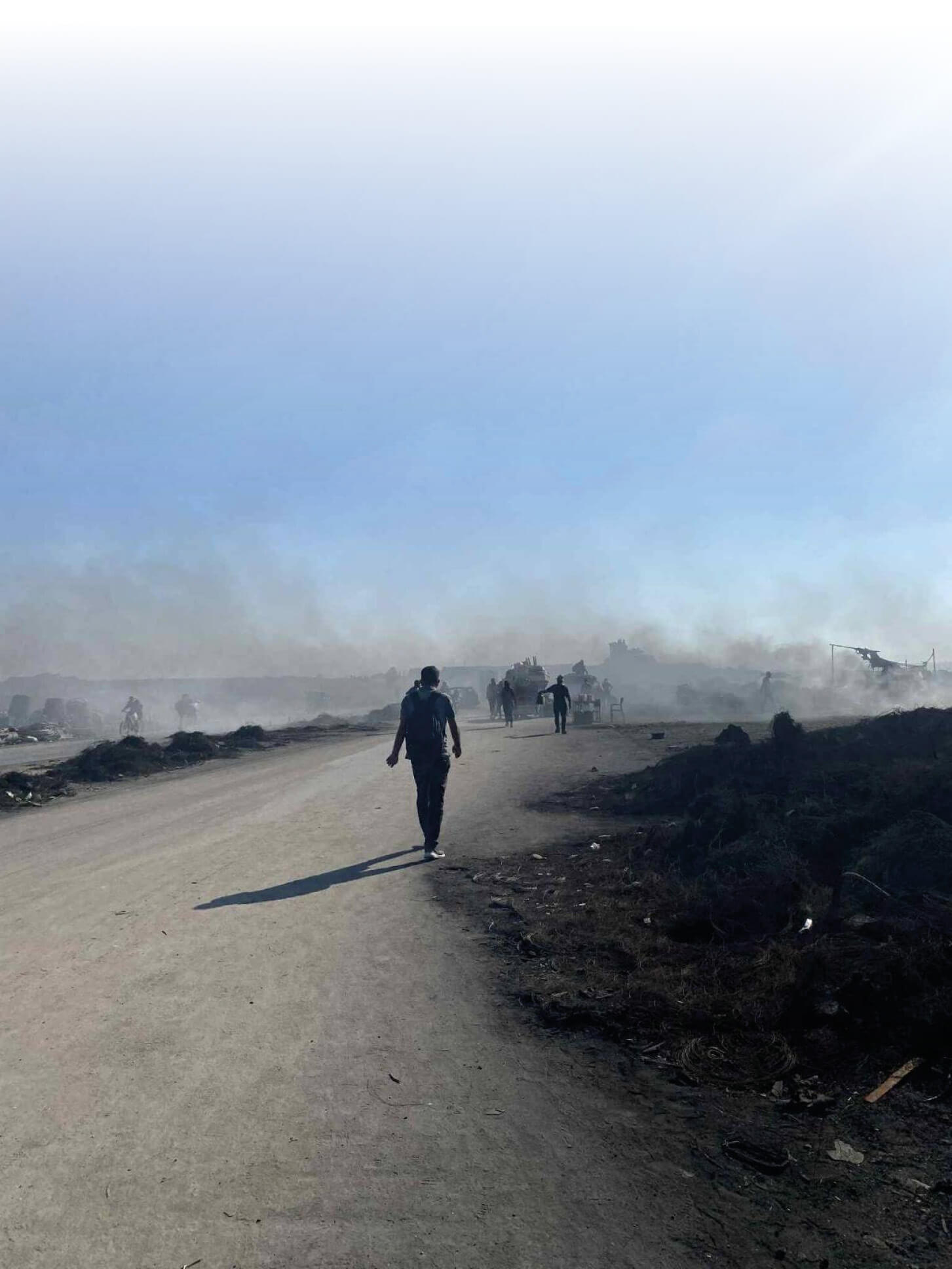
Right now, the situation in Gaza is beyond catastrophic. It is estimated that at least 230,000 Palestinians, around 10 percent of Gaza’s population, have been killed or injured since October 2023. Israel has, for nearly two years, continuously targeted Palestinians, destroyed residential areas and essential infrastructure, decimated Gaza’s healthcare system, and imposed a complete siege that has barred humanitarian aid, including food and medical supplies, from entering Gaza. These cruel tools of genocide have created a man-made famine and life-threatening living conditions caused by extreme pollution, overcrowding, and exposure to the elements.1
These are the conditions under which human rights defenders in Gaza are working. Every day, those who work with Al Mezan and their families face deliberate targeting, displacement, and intimidation. Human rights defenders in Gaza have always faced extreme risks due to the nature of our work, confronting Israel as an occupying power that has for decades demonstrated complete disregard for international laws and standards. Now, staff members in Gaza face even greater risk of being fatally targeted, as traveling to meet with victims and clients increases the risk of being caught up in an attack.
Gaza-based staff members have demonstrated heroic dedication to defending international human rights and upholding international law in Gaza, and they are doing so under unimaginably difficult conditions. Despite the extremely arduous work of supporting independent investigations and providing documentation and evidence of Israel’s genocide while we live in the midst of it, the international community has refused to take decisive action to stop Israel from continuing the genocide. This inaction has shamefully persisted in spite of the provisional measures issued by the International Court of Justice (ICJ) in January 2024, which triggered the Genocide Convention’s obligation to prevent it when they alerted states of the risk of genocide in Gaza. Evidence that this is a genocide has only accumulated. Reports published since October 2023 overwhelmingly point to the same conclusion: Israel is conducting a genocide in Gaza.2
Considering the ever increasing number of reports that state the same conclusion, it is no coincidence then that Israel and its allies have increased their efforts to silence Palestinian human rights defenders who dare to speak out. The intensifying attempt to silence Palestinian voices through undue punishment, intimidation, and even death is part of a decades-long campaign by Israel and its allies to minimize exposure of Israel’s crimes. Since 2023, Israel has consistently targeted Palestinian journalists to stop them from reporting on the genocide.3 Israel’s 2025 budget included a massive spending increase for its “hasbara” operations focused on changing perceptions of Israel on social media and in the international press.4

These developments of course pose a threat to our ability as human rights defenders to ensure that Palestinians’ stories areheard, but it pales in comparison to the impact that sanctions have had on our organization. In February 2025, the United States, Israel’s closest ally, began to impose an expansive and completely unjust sanctions regime to target the International Criminal Court (ICC) under Executive Order 14203. On September 4, 2025, Al Mezan, Al-Haq, and PCHR were sanctioned under this Executive Order for engaging in “efforts by the International Criminal Court (ICC) to investigate, arrest, detain, or prosecute Israeli nationals, without Israel’s consent.”5
In other words, we are sanctioned for exposing Israel’s international crimes and participating in the justice-seeking mechanisms that are currently available to us. These sanctions are politically motivated and are an egregious, blatant, and completely unjust attempt to punish those involved in investigating Israel and demanding that the Israeli political and military leadership be held accountable for the most horrific atrocities and crimes in living memory. These sanctions not only strip Palestinians of their access to justice but also intimidate all human rights defenders who have a duty to pursue legal remedies for justice.
These sanctions are explicitly intended to silence us, but we will not allow them to stop us from continuing to document and expose Israel’s international crimes. The effects of sanctions, however, are far-reaching. Our American partners have had to abruptly cut ties with us, ending existing partnerships in order to comply with US law. Non-US partners have also had to undertake risk assessments because they may have American staff members, branches in the US, or other American assets. International staff members have also had to resign due to the far-reaching consequences of these sanctions and the risk of reprisal.
International reaction to these sanctions has been hugely disappointing. The ICC is supposed to be an international law success story for Europe after the horrors of World War II, and yet, European governments have barely reacted to these sanctions with decisive action. It is clear that European and Western states have a clear double standard when it comes to human rights defenders advocating for Palestinian human rights. International human rights standards should be applied equally across the board. The fact that European states can uphold these dehumanizing double standards despite being the so-called champions of the current international legal system exposes the shortcomings of this system, especially when it comes to protecting human rights defenders.
International human rights standards are important and should remain so. They are undoubtedly relevant to our increasingly globalized and interconnected world; states need to adhere to them. We believe that a major shortcoming of the current structure of international law is that the mechanisms in place, such as international covenants and conventions, are not set up to prevent or stop violations quickly and decisively. Action often relies entirely on political will to take action, which completely undermines the efficacy of international law. This is true even for the Genocide Convention, which requires states to prevent genocide when there is even a risk of genocide and does not require them to wait until an international court has determined that genocide is being perpetrated, because at that point it would be too late. Despite the International Court of Justice’s indication of the risk of genocide in January 2024, there has been little response to this mechanism because there is no political will to act. From this example, it is clear that the mechanisms in place are incapable of preventing or stopping violations decisively, making them ineffective for human rights defenders.
The international community and especially human rights defenders have made great sacrifices to enshrine the human rights that everyone should enjoy. The values of freedom, justice, and human rights that are reflected in international covenants also represent the foundational principles of the United Nations and other international institutions that are supposed to equally apply international standards. The clear double standards when it comes to dealing with Palestinian human rights undermines global confidence in the effectiveness of this system and the accessibility of these mechanisms for human rights defenders. Therefore, although we believe that international human rights standards are relevant and play an important role in international law, enforcement measures and mechanisms need to be further developed and updated to keep up with contemporary challenges and fast-paced developments.
In addition to the general ineffectiveness of the human rights mechanisms available to human rights defenders, these processes are not even easily accessible. Participation in these mechanisms requires specialized legal knowledge that may not be easily accessed or even freely available to most individuals. For the human rights defenders diligently working for Al Mezan, there is the added layer of not being able to reliably access the internet to communicate and coordinate with colleagues or even conduct legal research to enhance the specialized knowledge required to participate in these forums.
Another major barrier for human rights defenders such as ourselves is the risk associated with participating in international justice-seeking mechanisms within a geopolitical environment that appears to be increasingly hostile toward human rights defenders. We have been subjected to more harassment and retaliatory measures, exemplified by the recent US sanctions. Together with the inherent threat and intimidation that emanates from these sanctions, the deafening silence from states that claim to support the rules-based international legal order deters other human rights defenders from engaging in justice-seeking mechanisms. Human rights defenders around the world cannot be expected to comfortably participate in international justice mechanisms such as the ICC when it is clear that the world will abandon them if they are sanctioned for their participation.
Nevertheless, we human rights defenders at Al Mezan will not be deterred from exploring creative solutions to the constraints imposed on us by the US sanctions regime. We will continue to advocate for justice and for Palestinian human rights to be upheld. Despite the challenges presented by these sanctions, we stress that these obstacles are nothing compared to the constant threat of death that follows our staff members in Gaza as they navigate how to survive Israel’s genocide and famine.
1 Al Mezan Center for Human Rights, “Time Is Running Out for Gaza: Al Mezan Calls for Immediate Action to End Israel’s Genocide, Starvation, and Mass Forced Displacement of Palestinians,” September 26, 2025; and Integrated Food Security Phase Classification, “IPC Special Snapshot on the Gaza Strip,” August 15, 2025.
2 Human Rights Watch, “Israel’s Crime of Extermination, Acts of Genocide in Gaza,” December 19, 2024; Amnesty International, “‘You Feel Like You Are Subhuman’: Israel’s Genocide Against Palestinians in Gaza,” December 2, 2024; B’Tselem, “Our Genocide,” July 27, 2025; Physicians for Human Rights – Israel, “Destruction of Conditions of Life: A Health Analysis of the Gaza Genocide,” July 2025; Médecins Sans Frontières, “Gaza Genocide,” last updated September 3, 2025; UN Independent International Commission of Inquiry on the Occupied Palestinian Territory, including East Jerusalem, “Legal Analysis of the Conduct of Israel in Gaza Pursuant to the Convention on the Prevention and Punishment of the Crime of Genocide,” September 16, 2025.
3 Al Mezan Center for Human Rights, “Kill the Witness, Hide the Crimes,” September 1, 2025.
4 Jewish Telegraphic Agency and Times of Israel Staff, “Foreign Ministry to Receive Massive Budget for Public Diplomacy Abroad,” Times of Israel, December 29, 2024.
5 Secretary of State Marco Rubio, “Sanctioning Foreign NGOs Directly Engaged in ICC’s Illegitimate Targeting of Israel,,” September 4, 2025.

Al Mezan Center for Human Rights is an independent, nonpartisan, nongovernmental human rights organization based in the occupied Gaza Strip. Since its establishment in 1999, Al Mezan has been dedicated to protecting and promoting the respect of human rights, especially economic, social, and cultural rights, supporting victims of violations of international human rights law and international humanitarian law, and enhancing democracy, community and citizen participation, and respect for the rule of law in Gaza as part of the occupied Palestinian territory.
