


By Majed Bamya
Leila Shahid embodied life for so long that I cannot associate her name with a eulogy. Anyone who met Leila remembers her as an incandescent being, whose light she would gladly share with anyone on her path. She would see everyone, care for everyone. She would listen, give advice, share a word or a laugh, deliver a reprimand, and offer comfort. She would tell stories. What a wonderful storyteller she was! – taking and exaggerating the traits of her characters, imitating their intonations, smirking as she prepared to deliver the punchline. She was so lively and lovely, just a force comfortably establishing itself in any environment. Present, and yet never overwhelming, finding a balance between being the life of the gathering and honoring every life within it.
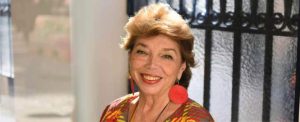
Leila studied anthropology – the exploration of humans and communities – probably as part of her search for meaning. Leila forged her own science, building the whole edifice on two fundamental columns: humanity and humility. Humanity gave her the ability to create connections with very different human beings – intellectuals, politicians, activists, artists, drivers, cooks, and passersby – and to enter every world and instantly be part of it. The ability to show empathy even when she herself was drained. The ability to follow people’s lives, to remember details, to pick up the phone and call to praise or convey concern.
Humility – not feigned but born of faith – enabled her to keep learning, to find greatness in others that nourished her own. Leila considered ego the Achilles’ heel of many able people, telling me that it turns the smartest people into dummies because bathing in their own light prevents them from seeking inspiration from others.
The humility and humanity of Leila the Great led her naturally to other greats and at the same time enabled her to find greatness where it is not necessarily expected: in each one of us.
Leila was Palestinian. I dare say she was an embodiment of Palestine, instantly recognizable, a superstar, especially in the countries of the francophone world. A beloved and admired figure, she introduced many to the cause of Palestine. Leila was equally universal in her beliefs and commitment. Her Palestinianhood was universal. She would want people to rally for the cause of Palestine based on universal values and would reject the support of those who were motivated by hatred and racism.
Leila was brave. When I sometimes shared my concern about her safety, she would brush the matter away, despite serious and visible threats. So how do we explain that such a being could no longer face this world? The answer is to be found in her profound sadness at the fate of Palestine, Lebanon, the region, Europe where she served as a diplomat for decades, and the world.
Leila was a singular phenomenon. Her uniqueness cannot be overstated. But Leila was also the daughter of an era. She was a daughter of the Palestinian revolution, one of the greatest liberation movements of the twentieth century. She was a daughter of the movements for liberation from all forms of oppression that shaped the previous century. She was from the generation born at the onset of the Nakba who decided to dedicate their lives to bringing it to an end; only to see it reach its ultimate stage in Gaza.
In 1982, Leila was among the first to visit the camps after the massacres of Sabra and Shatila. She brought with her the great French poet Jean Genet to become the witness of the massacres, to speak on behalf of the thousands murdered in cold blood – women, children, the elderly, men. Leila thought that if the world knew about the massacres, it would be moved to action. That became her mission. Letting the world know.
But what happens when the massacres are live-streamed day after day and still allowed to continue? Forty years later, as her people were being massacred in Gaza, Leila found herself on radio and TV again, confronted with the same lines of questioning that Palestinians had faced decades earlier. She saw her people depicted as terrorists, as barbarians, as subhumans, or at best as legitimate collateral damage.
Leila felt the darkness overtaking her country and the world. She fought back and tried to find meaning. There was anger against such injustice. There were moments of deep despair followed by a rebellion inherent to her character. Sometimes she would call me, euphoric about the movements she saw around the world, only to be overtaken later by despair at the news of another massacre.
How terrifying is this darkness that threatens to devour beings of light! But Leila did not surrender. She chose to leave before the darkness could prevail.
As I read through the many messages of love addressed to her after her death, I hope Leila knows that her light inspires many to believe that we will eventually prevail over the darkness. We must all now carry what Mahmoud Darwish described as the burden of hope; a burden that became too heavy for Leila. Inspired by her light. Missing her human presence.
Ambassador Majed Bamya, Deputy Permanent Observer of the State of Palestine to the UN, served with Leila Shahid when she was Palestine’s ambassador in Brussels. She was his mentor and the reason he joined Palestinian diplomacy.

A true depiction of Laila. Beautifully written.
Shukran Majed for the tribute you wrote about Leila’s light in life & death☀️ Leila , similar to your experience, inspired me with her humanity, as a woman and as a Palestinian, a proud one 🌹 Leila Shahid is unique warrior, her legacy will teach youth how to fight for rights with elegance and dignity.
May her soul rest in peace 🙏🏽
Cher Majed
Merci pour ce témoignage qui rend bien compte de l’enthousiasme si encourageant de Leïla et de ses qualités de conteuse. Tous ces dîners qu’on aurait dû enregistrer ! On pensait avoir le temps. Quelle tristesse! Bien à vous et à vos parents
Pauline de Laboulaye