


By Dalal Iriqat
Then the United Nations Security Council passed Resolution 1325 in 2000, it renewed its commitment to placing women at the forefront of peace and security. It recognized women not only as victims of conflict but also as essential agents of conflict resolution and peacebuilding. Twenty-five years on, there is no place where the disparity between rhetoric and reality is more evident than in Palestine.
The Gaza genocide, humanitarian protection breakdown in the West Bank, and Israel’s impunity reveal a harsh reality: the United Nation’s Women, Peace and Security (WPS) agenda has failed Palestinian women. As global leaders still talk about women’s empowerment, Palestinian women are living displacement, starvation, and violence while holding families and communities together. Their leadership is invisible, their rights are unprotected, and their dignity is bartered at the altar of geopolitics.
The Gaza crisis has a very human face, and it is mostly that of women. Women and children have made up more than 70 percent of those killed or injured since October 2023 – a contrast with previous wars when men were the majority of victims.1 This indicates that women are no longer collateral damage; women have been deliberately placed in the line of fire in a conflict that militarizes displacement, starvation, and family destruction. Take the story of six-year-old Hind Rajab, whose desperate final phone call pleading to be rescued after her family had been massacred in their car became a searing symbol of innocence crushed by systematic violence. Or the tragic example of Dr. Alaa al-Najjar, a pediatrician who saw that nine of her ten children – including her baby daughter – had been killed in an Israeli air raid on Khan Younis while she was at work trying to save the lives of other children. In spite of this incalculable loss, she still practices medicine, a testament to resilience in the face of sorrow.2

Other women have converted their despair into collective empowerment. Hanady Lulu, who lost her entire family, pulled herself and her only surviving child from the rubble to create the Samir Foundation that provides medical and mental healthcare to thousands. Meanwhile, voices like that of Hiba Zayyan, forcibly displaced to Egypt, have continued to advocate globally under the WPS agenda, ensuring that Palestinian women’s voices are not lost in global agendas.3 Social workers Hayam Farhat and Faten Harb now live in the tents among the Gazans displaced to the Al-Mawasi area, yet they work on a daily basis to help their community, and women in particular, survive and keep the social fabric together. These women are not carrying out one-off acts of heroism – they are part of an extensive history of Palestinian women sustaining life under siege: running shelters, bringing food, counseling for trauma, and holding together communities that have been ripped apart by violence.
Yet even though women are bearing the heaviest burdens and exemplifying extraordinary leadership, they continue to be absent at the negotiating tables where their futures are decided. Their work is not even relegated to footnotes, as if survival work and grassroots leadership were less important than high diplomacy. This erasure is not merely a question of injustice – it is dangerously nearsighted. Peace without women is neither stable nor sustainable. To exclude Palestinian women from reconstruction and governing processes is to ignore the very actors who have made life in Gaza possible, enabling their families and communities to survive.
Twenty-five years after the issuing of WPS, Palestine is the case study textbook example of how in the face of political reluctance the resolution can be diluted into meaningless rhetoric.
Resolution 1325 is based on the four pillars of participation, protection, prevention, and relief and recovery. All four are mere rhetoric, all four have failed in Palestine.
Participation: Women have been excluded from high-level negotiations, from Oslo to Annapolis and beyond, as well as from reconciliation tables for intra-Palestinian dialogue for unity. This denies half the population a voice in their future.
Protection: International law requires combatants to protect civilians. Palestinian women are instead vulnerable to bombardments, settler violence, and harassment at checkpoints.
Prevention: Root cause analysis is at the heart of the UN’s Women, Peace and Security agenda. But the root cause of Palestinian misery – continued military occupation – is never discussed.
Relief and Recovery: Relief and reconstruction consistently overlook women’s needs, from reproductive health to psychosocial support.
Feminist critiques of international responses are worth touching upon. Feminist scholars such as Cynthia Enloe have long warned that the WPS agenda risks tokenism if power relations remain unchallenged.4 In Palestine, this critique is glaring. Global players talk of empowering women but fail to hold back Israel’s military invasion and occupation. Palestinian women are positioned as recipients of charity rather than political agents of change. This erasure is a hallmark of colonial paternalism, where the situation of women is recognized by global powers only when convenient.
Yet Palestinian women have been agents of peacebuilding: In spite of structural marginalization, they have continued to shape resistance and peacebuilding. During the first Intifada, women initiated boycotts, established underground schools, and maintained alternative economies. Today, women’s groups such as the Palestinian Working Woman Society for Development, the General Union of Palestinian Women, and the Ministry of Women’s Affairs document abuses, assist survivors, and organize advocacy at the UN. Women in Gaza’s shelters are organizing food delivery, informal education, and trauma counseling. They are peacebuilding in practice, even if the international system does not necessarily define their actions as such.5
Structural impediments to women’s leadership continue: Even as their fundamental contributions are acknowledged, Palestinian women are structurally excluded from formal political decision-making institutions not only in Gaza but also in the West Bank and all of occupied Palestine – an exclusion driven by patriarchy and colonialism. Military occupation structurally bureaucratizes gendered violence: curtailment of mobility, economic repression, and marginalization severely constrain women’s access to education, to the economy, and to the public sphere. These are not simply secondary effects of war but instruments of dominance that enshrine patriarchal hegemony and prevent any possibility of inclusive governance.
The diplomatic fatigue we are witnessing has a gendered cost, as it effectively legitimizes gendered violence and grants the perpetrator impunity!
At the same time, the entrenched male hegemony that prevails in Palestinian political organizations such as the Palestine Liberation Organization (PLO) and the Palestinian Authority limits women’s access to leadership. Even activities that are self-consciously bounded by international norms, such as UNSCR 1325, seldom do more than ensure a token participation. Funds, training, and planning provided by donors are all too often ineffectual in leading to political change. Decades of overseas assistance spent on gender empowerment has yielded too little structural change – a disappointment symptomatic of a broader aversion to grappling with the intersection of colonialism and patriarchy.

Faced with a well-documented, 24-month genocide, and on the 77th anniversary of an unremitting Nakba, we have never been more in need of turning around and looking critically at the politics and society that we’ve constructed. And along the way, we must confront a blinding, decades-long rarely spoken truth: Palestinian women are systematically denied the seat of decision-making.
From armed resistance to diplomacy, from street activism to political platforms across the globe, Palestinian women have led the struggle for resistance and change for decades. And yet, despite all their tireless efforts, real political representation remains far, far removed for Palestinian women. If we dig deeper into the numbers, the truth is even worse – and chilling.

Women constitute 49.3 percent of the Palestinian populace and 49.6 percent of public sector workers. But they occupy only 14.9 percent of leadership positions (director general and higher). Women comprise 26 percent of local government council members, but only 5 percent are deputy heads, and less than 1 percent (0.7 percent) are council heads. At the cabinet level, women occupy no more than 14.3 percent of ministry seats – a total of just four ministers – and there is one lone woman governor among sixteen in the West Bank and Gaza (6.3 percent). In the police force, a stingy 4.5 percent are women. In the PLO, it is not much better: not a single woman is on the Executive Committee. Women occupy 13 percent of the seats in the National Council and 30 percent of Central Council seats.
World leaders must move from the long-overdue recognition to carrying out responsibility.
In foreign affairs institutions, only 17 percent of the Palestinian ambassadors who travel abroad to represent the nation are women, even though women make up 57 percent of the Ministry of Foreign Affairs’ public servants and 44 percent of foreign affairs officials.
Similarly, in the medical, academic, judicial, and business fields, Palestinian women are noticeably underrepresented in leadership roles: for example, although they constitute 30 percent of faculty at universities, they occupy only 10.7 percent of university board membership seats.
These figures speak of a continuing exclusion. Enabling larger numbers of Palestinian women to take on the highest decision-making positions is not a token to be shown to the international community; it is an internal matter of legitimacy and a national imperative.
The exclusion of women from political representation is a conscious exclusion of half of Palestinian society and prevents them from actively forming the very democracy that we wish to preserve in international institutions. Women in Palestine have a double burden: one of occupation and oppression, and one of politics and structural barriers in society. And yet, women have persistently proven their leadership, creativity, and presence in academia, diplomacy, civil society, and so forth.
It is time that we stop treating Palestinian women as a “special case” to be dealt with by tokenism.
In order to shift the WPS agenda from rhetoric to reality, what would it require for Palestine to be the test case of a serious WPS agenda?8
Accountability: Bring an end to impunity for war, occupation, and settlement crimes. International law needs to be implemented, not merely invoked.
Inclusion: Ensure women’s equal involvement in any peace process. The experiences of Liberia and Northern Ireland demonstrate that women’s involvement renders peace agreements more durable.
Gender-Responsive Aid: Reproductive health, psychosocial support, and protection from gender-based violence should be prioritized in humanitarian aid.
Sanctions and Pressure: Go beyond symbolic recognition. Prohibit settlement products, end arms exports to Israel, and sanction war criminals.
Empowerment of Grassroots Women’s Movements: Fund directly Palestinian women’s organizations that already provide for besieged communities.
Instead, we must re-envision our model of national leadership so that women’s voices, experiences, and vision are incorporated in an organic manner. Inclusive leadership is not only a political imperative – it is the foundation for any fair and sustainable future for Palestine. If gender justice is ever to be had in Palestine, it must be conceived of as a national and political necessity. It is not a question of seats on backwater committees or quotas. Palestinian women are not a “segment” of society – they’re half of it and must be regarded as such in any government and negotiation forum.
Decades of impasse have left the international community reeling from “diplomatic fatigue.” The 2020 Abraham Accords entirely sidestepped Palestinian rights, instead focusing on normalization between Israel and Arab countries. For women, this fatigue means diminishing aid, less advocacy, and reduced visibility. This fatigue is not neutral. It legitimates impunity. By overlooking the occupation, the world normalizes gendered violence and entrenches Palestinian women’s dispossession.
The degradation of Gaza’s health infrastructure renders gendered repercussions unavoidable. The World Health Organization informs us that more than 60 percent of Gaza’s hospitals are currently out of commission.6 For women, this has meant that pregnant women are giving birth without anesthetics. C-sections are being performed by candlelight or phone torches. Breast cancer patients have been unable to receive chemotherapy. And menstrual hygiene products are so unavailable that women are resorting to using unsafe alternatives.
These circumstances demonstrate how humanitarian responses habitually neglect to meet women’s needs.
The latest diplomatic flurry – with Saudi Arabia and France leading a tsunami to recognize the State of Palestine along with ten major powers – namely, the UK, Belgium, Canada, Australia, Portugal, Malta, Luxembourg, San Marino, Andorra – is symbolically significant. However, recognition is not sufficient. Without mechanisms to rescue women from violence, halt the growth of settlements, and ensure accountability, statehood may become no more than another hollow promise. As feminist theorists remind us, peace is not the absence of war but the presence of justice. Justice for Palestinian women necessitates dismantling settler colonialism, ending occupation, and inserting women into decision-making.7

In conclusion, we can assert that justice is a precondition for peace!
The Palestinian example lays bare the hollowness of the WPS agenda when it is severed from justice. Palestinian women are not passive victims or helpless bystanders. They are leaders, organizers, and peacebuilders. Their role must be respected by the international community through a shift from rhetorical commitment to tangible action. Ending the occupation, holding perpetrators accountable, and empowering women as equal partners are not optional measures – they are the imperatives of sustainable peace.
Once the genocide ends and reconstruction begins, it cannot end with buildings and roads – it must rebuild trust, justice, and social fabric. And this cannot be done without the leadership of women. Palestinian women are organizers, mediators, and custodians of life under siege. The question is not whether women will rebuild Gaza – they already are – but whether their leadership will be respected and institutionalized.
Gender-blind reconstruction threatens to replicate past injustices. Whether it concerns well-meaning aid that bypasses women’s organizations or security policies that ignore community-level grievances and gender violence, in order to be credible, peace must be fashioned by women at all levels of governance, reconstruction, and justice. A feminist reconstruction requires women in decision-making roles in reconstruction agencies, gender audits of aid, and gender-sensitive monitoring mechanisms. Women’s participation in governance, transitional justice, and peace negotiations must be guaranteed. Otherwise, reconstruction will entrench inequality rather than heal it. Overall, the reconstruction of Gaza and the day after for Palestine must be feminist: inclusive, participatory, and grounded in women’s lived experience. Anything less risks replicating exclusion and undermining peace itself.
Networks such as the Women, Peace and Security Working Group in the Arab States Region, the Mediterranean Women Mediators Network, and the Global Alliance have already set an example: they are uniting women across borders, opening doors to diplomacy, and mainstreaming feminist leadership in peacebuilding. This is not symbolic inclusion – it is structural change.9 If the WPS agenda is to have any meaning at all, Palestine has to be its litmus test. Anything less is complicity in injustice.
1 UN Women, “Gender Alert: The Gendered Impact of the Crisis in Gaza,” January 2024.
2 Dalal Iriqat, “The Need for Palestinian Women’s Leadership in Recovery and Peacebuilding,” July 2025, ISSN 2532-6570, Mediterranean Women Mediators Network (MWMN) and Istituto Affari Internazionali (IAI).
3 Ibid.
4 Cynthia Enloe, Bananas, Beaches and Bases: Making Feminist Sense of International Politics, University of California Press, 2014.
5 Mirvat Al-Zaqaouq and Diab Zayed, “Palestinian Women: Between War Resilience and Their Role in Post-Conflict Reconstruction in Gaza,” UN Women, March 2025; UN Women, “Palestinian Women-Led Organizations Must Be at the Forefront of the Rumanitarian Response in Gaza and the West Bank,” June 10, 2024.
6 Director General, World Health Organization, “Health Situation in the Occupied Palestinian Territory,” May 19, 2025.
7 Marie O’Reilly, Andrea Ó Súilleabháin, and Thania Paffenholz, “Reimagining Peacemaking: Women’s Roles in Peace Processes,” International Peace Institute, June 2015.
8 Dalal Iriqat, “In Post-Genocide Gaza, Women Will Rise from the Rubble,” AFKAR, the Middle East Council on Global Affairs, March 9, 2025.
9 Dalal Iriqat, “Women After War: At the Helm of Rebuilding and Recovery in Gaza,” Issam Fares Institute for Public Policy, American University of Beirut, March 9, 2025.
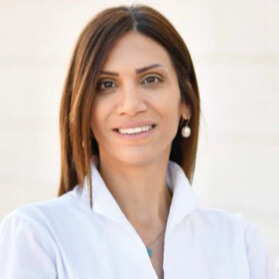
Dr. Dalal Iriqat is an associate professor at the Arab American University Palestine AAUP. She has been a weekly columnist at Al-Quds newspaper since 2016 and was identified as a Young Global Leader at the World Economic Forum YGL 2021. She is the founding president of Business and Professional Women BPW Palestine 2022.
