


Courtesy of UN Human Rights Office in the Occupied Palestinian Territory
Mayson is a 37-year-old widow from Beit Lahia, Gaza, a mother of a five-year-old son, and a person with disability. She shared her story and plea for the future with the UN Human Rights Office in the Occupied Palestinian Territory (OHCHR OPT).
“I was born with a vision impairment, and I have a glass eye. My husband was the miracle of my life, my rock, and my support. I was happy and safe with him. But the story was cut short.
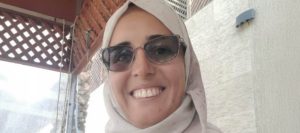
“We are from Beit Lahia in northern Gaza. Things were tense there from day one; airstrikes never stopped. We lived in the same building as my husband’s extended family. The bombing was scary and kept intensifying. My sister and I took my son and sought refuge in a school building. My husband was supposed to join us the following day. But his phone stopped ringing. I called everyone in the building, everyone in my husband’s family. Phones were not ringing. One number finally rang. Someone picked it up. He said everyone is dead. It was a fire belt; airstrikes killed everyone. I searched for his body in hospitals. I showed his photo to the nurses. I couldn’t find him anywhere. My brother came to take me south, but I wanted to see my husband. My brother paid for a bulldozer, which kept digging for a week. My husband’s body never recovered. I wish I had stayed with him and never left the house. This was in October 2023, just a few days after the war started. It has now been over two years since I lost him. I never had the chance to say goodbye, or to honor and bury him with dignity. There is no grave to visit.

“Since I left my house in Beit Lahia, I do not remember how many times I have been displaced. I can count at least 16 times. In the first tent, my son couldn’t stop crying for his father, and people around us kept yelling at me to keep him quiet. Everyone was grieving. Everyone was suffering. There was no space for his grief.
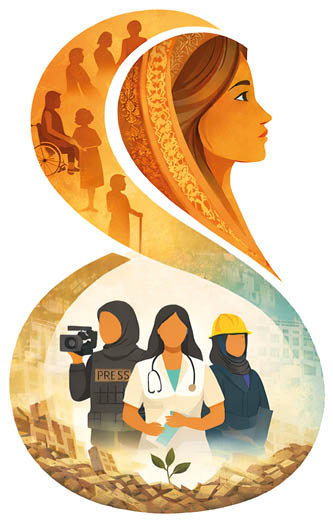
On International Women’s Day, the offices of UN Human Rights, UN Women, and the United Nations Population Fund in Palestine launch the “We Survive, We Lead” campaign to amplify the lived experiences of Palestinian women. In partnership with Taawon (Welfare Association), we present stories of suffering, resilience, and leadership as a testimony and a clear call to action to uphold and protect dignity and human rights.
“The war is not over for me. It was raining the other day, and my tent was flooded. All night, I cried while carrying my son from one spot to another inside the tent to try to keep him dry.
“I do not forgive the world for what has happened, for what keeps happening. My son spent two of his five years in this world in war, without his father, and in extremely difficult conditions. He has speech and learning difficulties, and there are no facilities to help him.
“If I ever leave Gaza, it will be to get a new glass eye. It has been painful, and I haven’t been able to get medical attention for it. If it were not for Stars of Hope,* I would not have had a shelter and been able to support and feed my son.
“I had a life and a home. My son had a father. Now, it’s all gone. There is no clarity. It feels like we are heading into the unknown. And the war is just not ending. I can’t even protect my child from the rain.”
*Stars of Hope is a Palestinian NGO focused on the rights of people with disabilities and partners with the United Nations Country Team’s Disability Inclusion Working Group, which is led by the UN Human Rights Office in the Occupied Palestinian Territory (OHCHR OPT) and UN Women. Stars of Hope is also part of the Protection Cluster which is coordinated by OHCHR OPT.
