



Courtesy of CARE Palestine
In Palestine, women’s leadership is a visible reality, including on International Women’s Day. Across communities, women sustain institutions, manage families, deliver services, run enterprises, and shape civic life under occupation, economic contraction, and recurring humanitarian crisis. Yet systems remain fragile: Women-led organizations face limited investment, while entrepreneurs and micro, small, and medium enterprises owners navigate shrinking markets and restricted mobility.
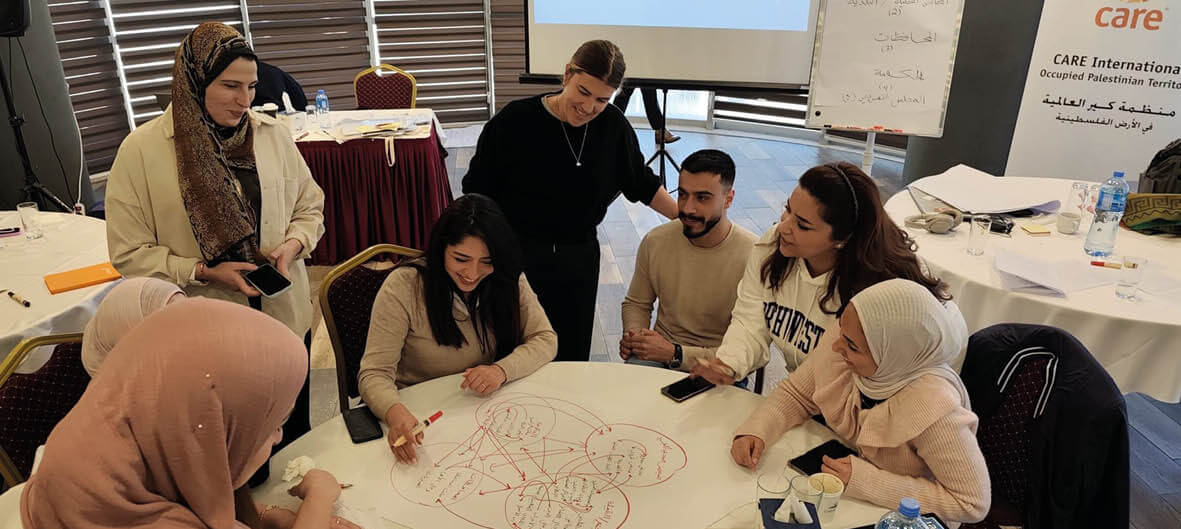
CARE’s Women Equality and Empowerment (WEE) portfolio supports women’s agency, connecting institutional support with economic opportunity. The approach advances women’s agency, shifts power relations within households and institutions, and reforms systems that shape access to resources and decision-making. With support from donors, collaboration across the CARE global network, and partnerships with local actors, this approach strengthens change from communities outward.
In context of shrinking civic space and volatile funding environments, institutional fragility can undermine feminist movements. Women Voice and Leadership (WVL) program strengthens CARE’s long-term investment in institutional resilience, replacing transactional grants with trust-based partnership. Through rapid response mechanisms, multi-year funding, capacity strengthening, and sisterhood networks, WVL promotes women-led organizations as local humanitarian leaders and rights advocates shaping agendas.
Sukaina Khalawi, of Women Media and Development (TAM) states, “This experience was more than a set of implemented activities. It created space for learning, exchange, and shared decision-making, where localized leadership was visible and communities were engaged as key actors of change.”
To strengthen economic resilience, CARE established the AMALI and WATAD projects, supporting displaced women, integrating skills development, mentorship, and market linkages. around 150 grants provide financial and nonfinancial support to help women stabilize and grow their businesses.
CARE applies an integrated approach to women’s equality and empowerment in Palestine. For example, its Women Voice and Leadership (WVL) program considers institutional strength as power, building trust-based partnerships among women-led organizations. Other programs aim to advance women’s agency and participation in social and economic transformation.
Salam Bayatneh, founder of Peace Pieces Jewelry, joined AMALI when restricted mobility and declining purchasing power reduced her sales. Through training, digital tools adoption, and grant support, she diversified her products, strengthened her planning, and expanded her market reach. Today, her business has stabilized and grown, generating income for her household and creating jobs for other women. She explains, “joining AMALI was a turning point for me and for Peace Pieces Jewelry. It gave me the space to think bigger, refine my vision, and grow despite the challenges. Through mentorship and connecting with inspiring women, I strengthened my leadership and began managing my business strategically. The impact was not only professional, but deeply personal; my hesitation turned into confident steps forward.”
For displaced women, economic loss comounds trauma and restricts recovery. By restoring income-generating activities and reconnecting women to markets, the initiative bridges humanitarian response with long-term recovery.
The Powered by Women (PbW) project advances leadership, civic participation, economic justice, sexual and reproductive health and rights, and social norms transformation. Through flexible, women-governed grants and the Women Lead in Emergencies model, it strengthens emergency leadership, advocacy capacity, and meaningful participation in decision-making. These layers form a cohesive ecosystem connecting institutions, livelihoods, and leadership to shift power.
Across CARE’s Women Equality and Empowerment (WEE) portfolio, institutional strength, economic agency, and collective leadership drive change. Women-led organizations stabilize communities, entrepreneurs strengthen local economies, and feminist networks sustain solidarity. Palestinian women are not merely surviving crises; they are redesigning the systems shaping their future.
Palestine Innovation Initiative (PII) is a coordination platform that brings together universities, practitioners, and philanthropic or investment-aligned partners to develop applied AI capability consistent with global practice. Its work centers on coordinated training, applied engagement, and the development and export of AI-enabled skills.
