


By Jalal Al Husseini
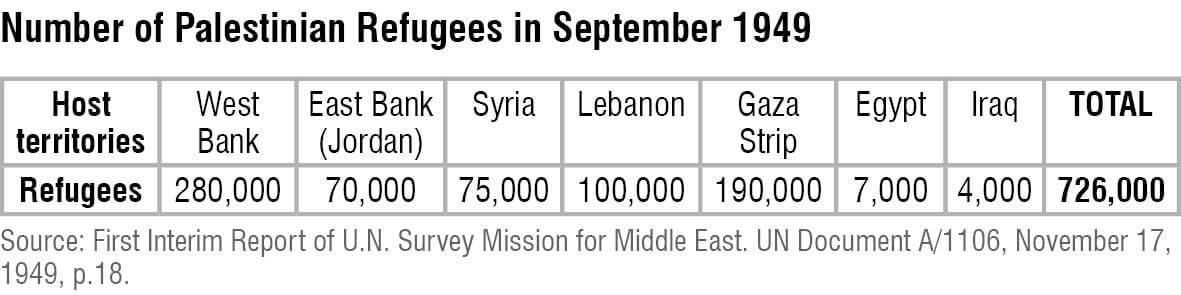
In the aftermath of the Nakba, approximately 730,000 members of the Arab population of Palestine were displaced from their homes and deprived of their means of livelihood, becoming refugees primarily in neighboring territories, including Jordan (including the West Bank), Lebanon, Syria, and the Gaza Strip, as well as in other countries such as Iraq and Egypt.
In Palestinian narratives, the Nakba and the transformation of the vast majority of the Arab population of Palestine into refugees are understood as the outcome of a process set in motion by the 1917 Balfour Declaration, through which Britain, as the Mandatory power in Palestine, committed to supporting the establishment of a national home for the Jewish people. This process culminated in the establishment of Israel in 1948, at the expense of the Arab population’s aspirations for self-determination –aspirations that had been encouraged during the First World War through Allied commitments to local actors in their struggle against the Ottoman Empire. The Nakba is further portrayed as the starting point of a prolonged trajectory of displacement and suffering, during which Palestinian refugees have struggled for survival across the Arab world while facing discrimination and recurrent episodes of violence and occupation over subsequent decades.
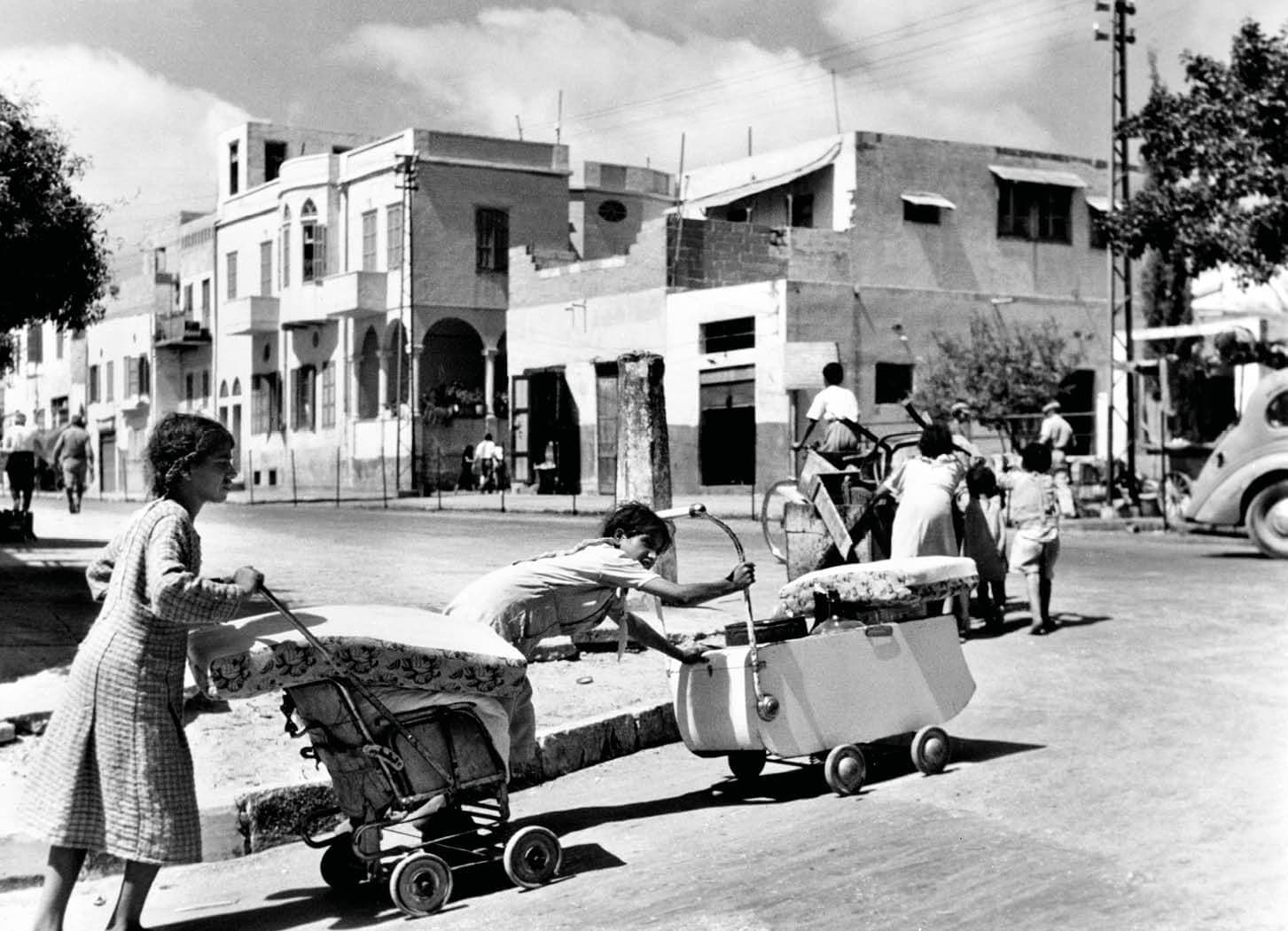
Following their dispersal across the Middle East, Palestinian refugees – stateless and initially lacking a unified national leadership – were, from 1949 onward, subject to a legal framework devised by the Arab League. This framework, which remains largely in force, rests on two principal pillars. First, it affirms support for the refugees’ repatriation and the safeguarding of their rights to property, life, and liberty, principles also reflected in UN General Assembly Resolution 194 (December 1948). Second, it promotes the maintenance of refugees as stateless residents pending repatriation – as a form of positive discrimination intended to preserve their distinct Palestinian identity and, by extension, their right of return.
The UN General Assembly that in November 1947 adopted Resolution 181, which gave the Jewish state international legitimacy, is the very same one that gave international legitimacy for the right of the Palestinian refugees to return. These two principles are intertwined.
To mitigate the adverse socioeconomic effects of statelessness, particularly restricted access to public-sector employment and national welfare systems, the Arab League further recommended that host countries grant Palestinian refugees a set of social rights. These include residence, freedom of movement, and access to employment and to public services on a basis comparable to that of the host population. Such provisions complemented the educational, medical, relief, and social services provided by the United Nations Relief and Works Agency (UNRWA), which since May 1950 has addressed the basic needs of vulnerable refugees in the main host areas (Jordan, Syria, Lebanon, the West Bank, and the Gaza Strip), while also promoting their socioeconomic reintegration.
Arab countries have implemented this legal framework in varying ways, reflecting their respective political and economic considerations. In the initial decades, most host countries adhered to the recommendations of the Arab League, with some – such as Syria and, at later stages, certain Gulf countries – even granting Palestinians access to public-sector employment. Lebanon and Jordan, however, followed distinct trajectories. In Lebanon, citizenship was selectively granted in the 1950s to certain groups, notably Christians and economically privileged refugees, in order to preserve the country’s sectarian balance; more broadly, citing limited absorptive capacity, local authorities have imposed restrictions on access to regulated professions, property ownership and inheritance, social security, and public services. By contrast, Jordan – which annexed the West Bank in 1950 – granted citizenship in the early 1950s to the entire Palestinian refugee population, pending their eventual return, thereby facilitating their participation in the country’s development process.
Against this backdrop, two enduring trends have shaped Palestinian refugee communities over subsequent decades. At the socioeconomic level, a population that was predominantly agrarian in 1948 was gradually transformed into an urban workforce following the loss of access to agricultural land in exile. Successive generations benefited from the general education and vocational training provided by UNRWA and host states, leading to the emergence of a skilled labor force that was employed primarily in the fields of education, services, and industry. From the 1960s onward, many of them migrated to the oil-producing Gulf countries, where expanding economies offered significant professional opportunities. These migration flows not only enabled individual advancement but also generated substantial remittances, which have since constituted a key pillar of both refugee household incomes and the economies of several host countries, including Jordan and Lebanon.
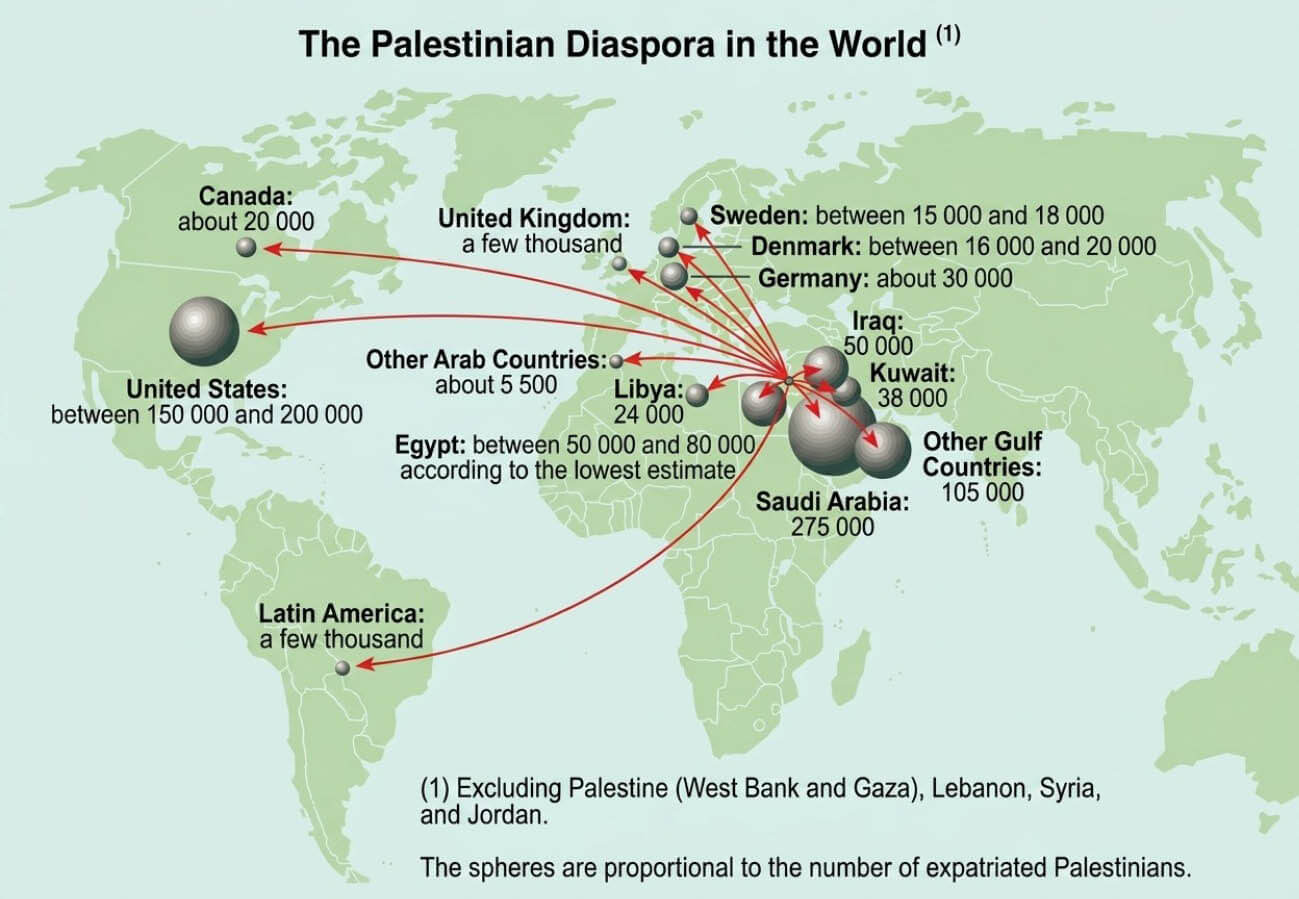
At the political level, dispersed refugee communities progressively coalesced into a coherent social and political entity. The anti-assimilationist legal framework – anchored in the internationally endorsed “right of return” – and the continued presence of UNRWA as a dedicated institutional actor contributed to the consolidation of a shared identity across geographically fragmented communities. Concurrently, patterns of social organization evolved from the reconstitution of family- or village-based networks to broader transnational linkages that spanned host countries and beyond. This process fostered a strengthened sense of collective belonging to Palestine.
Within this context, the establishment of the Palestine Liberation Organization (PLO) in 1964 – under the auspices of the Arab League, which initially conceived it as an instrument of pressure against Israel – contributed to the consolidation and expansion of Palestinian nationalism across the diaspora. This trajectory was further confirmed in 1974, when the PLO was internationally recognized as the representative of a “Palestinian people,” defined as “the Arab citizens of Palestine until 1947, whether they were forced to leave or remained there, as well as any person born to a Palestinian parent after that date, whether in Palestine or outside it.”
The emergence of the Palestinian national movement resonated among Palestinian communities beyond the Middle East, including in Europe, the United States, and South America, where long-established and, in some cases pre-1948, naturalized communities had often been regarded as fully assimilated into their host societies. This process of reassertion took multiple forms of political engagement, including participation in PLO representative offices, as well as the establishment of advocacy associations and nongovernmental organizations supporting vulnerable Palestinian populations, particularly in the occupied territories and in Lebanon.
Yet a number of developments have undermined the cohesion of the Palestinian diaspora and its trajectory toward self-determination. Foremost among these are the contentious nature of the relations between the PLO and several Arab countries, which has undermined the actual status of Palestinian refugees by framing them as destabilizing actors. Notable examples include Jordan, where PLO factions confronted the national army during the “Black September” events (1970–1971); Lebanon, and to a lesser extent Syria, where PLO factions became entangled in civil conflicts (1975–1991 and 2011–2024); and the Gulf countries following the PLO’s refusal to condemn Iraq’s invasion of Kuwait (1990–1991). These developments contributed to tightening legal restrictions and, in some cases, to triggering large-scale population displacements. In Lebanon, more than half of the refugees registered with UNRWA (i.e., 268,000 out of 490,000) currently reside abroad, particularly in Germany and northern Europe. Similarly, the large majority of the approximately 400,000 Palestinians who lived in Kuwait prior to 1990 were expelled, many returning to previous host countries, including Jordan, and the West Bank. In Jordan, host to the largest registered Palestinian community since 1967 (representing roughly half of the Jordanian population), concerns over the potential establishment of an alternative Palestinian state on its territory – a scenario frequently promoted by Israeli right-wing political actors since the late 1970s – have contributed to patterns of discrimination affecting Jordanians of Palestinian origin, particularly with regard to access to senior administrative and political positions.

The deterioration of the status of Palestinian refugees in several Arab countries has in many cases redirected political engagement toward the pursuit of improved living conditions and affiliation to local, often Islamist, political parties. Of greater long-term significance, however, has been the strategic shift in the objectives of the national movement, and the associated definition of “Palestine” that was adopted by the Palestinian leadership following the establishment of a regional status quo in the aftermath of the Arab “semi-victory” in the 1973 conflict. This shift, formalized in the 1988 proclamation of the State of Palestine and further consolidated through the 1993 Oslo Accords, entailed a reorientation of Palestinian claims toward the establishment of a Palestinian state limited to the territories of the West Bank and the Gaza Strip (WBGS). Together, these territories represent no more than 22 percent of historic Palestine.
While presented as a pragmatic approach, this redefinition has failed to provide clear answers to key concerns about the future of refugees and, more broadly, the Palestinian diaspora. These concerns include the scope of the right of return and four related questions: whether it should be confined to the West Bank and Gaza Strip, despite the latter’s limited absorption capacities; the status of refugees already residing in the WBGS (approximately 40 percent of all UNRWA-registered refugees, constituting roughly two-thirds of the population in Gaza and one-quarter in the West Bank); the prospective citizenship of refugees who live outside the WBGS; and the role the diaspora is expected to play in the state-building process.
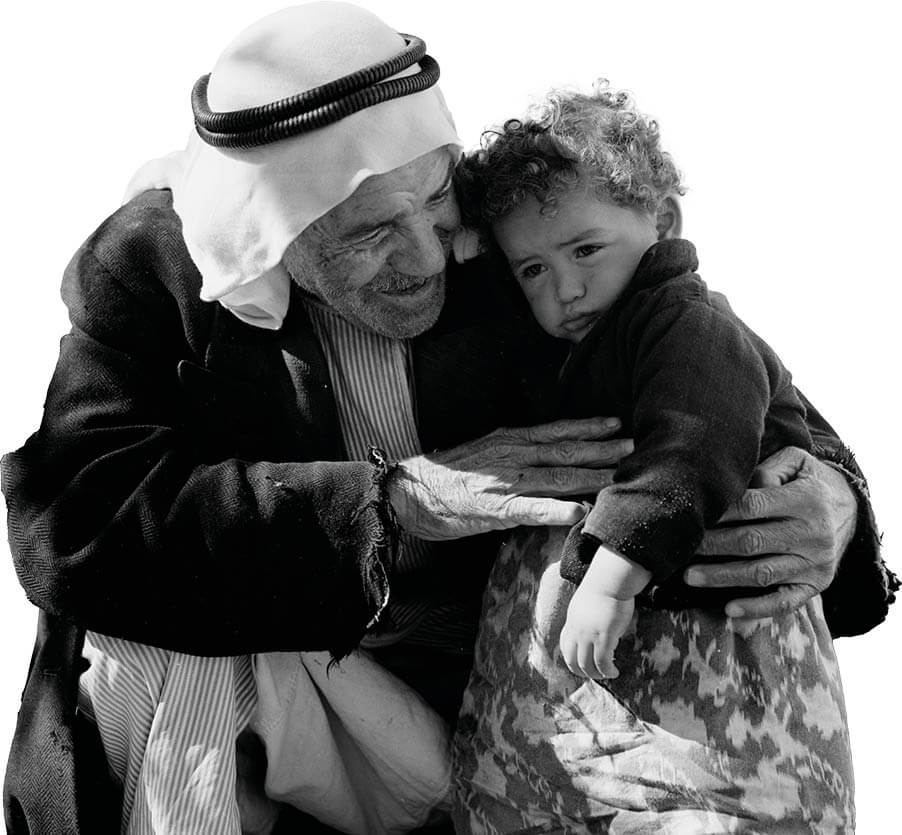
These issues have been sidelined due to several factors. Chief among them is the deferral of the refugee issue within the Oslo Accords framework, which classified it as a “permanent status” issue to be addressed following interim arrangements for autonomy in the WBGS. This sequencing has in practice contributed to its marginalization, which has subsequently been compounded by the collapse and prolonged suspension of the Israeli-Palestinian negotiations since the failed 2007 Annapolis Conference.
At the same time, the Palestinian leadership, which has headed both the PLO and the Palestinian Authority (PA) in the WBGS since 1994, has shown limited willingness to engage openly with the refugee communities on the implications of these developments, amid concerns that such debates could challenge its claim to exclusive representation. Attempts by diaspora communities to assert themselves as autonomous actors within the Palestinian polity through conferences or mobilization initiatives have been systematically constrained.
More broadly, substantive debates have been overshadowed by the internal division of the Palestinian polity between the PA led by the secular PLO-affiliated Fatah movement that administers the West Bank on the one hand, and Hamas, the Islamist faction that has controlled Gaza since 2007 on the other. Israel’s onslaught on the Gaza Strip and large-scale military actions, combined with the accelerated expansion of settlements in the West Bank since 2023, have raised the prospect of future large-scale displacements and further cast more doubt on the future trajectory of the Palestinian national movement.
The setbacks experienced by the national movement, particularly with regard to the refugee issue, should not, however, be interpreted as evidence of its disappearance. At the diplomatic level, the international recognition of the “Palestinian people,” further reinforced by Palestine’s elevation in 2012 to non-member observer State status at the United Nations, remain key achievements. At the field level, the continued mandate of UNRWA attests – despite recurrent funding constraints – to the United Nations’ ongoing commitment to fulfil the provisions of Resolution 194, including the principle of refugee return and the provision of compensation as a possible alternative.
Nonetheless, the State of Palestine today increasingly appears as a weakened and largely symbolic construct that falls short of representing and advancing the aspiration of refugees inside or outside Palestine. Recent developments suggest a return to the pre-PLO era, when the most significant guarantor of Palestinian identity, beyond the formal legal and institutional structures established by Arab states and the United Nations, was constituted by transnational networks sustained by refugee families, arguably the most enduring Palestinian institution.

Jalal Al Husseini is a research fellow in political sociology at the French Institute for the Near East (Ifpo–Amman Branch) and a consultant for international assistance agencies, including UNRWA.
