


By Sura Abualrob
The Nakba is not a historical chapter we turn to. It is a continuing structure that is embedded in the fabric of everyday life, a wound that does not close. It is present in the gnashing sound of bulldozer arms that tear into the nearby hill, a force that has not ceased for over seven decades to reshape our forced space. It lingers in the texture of stone and in the cold persistence of loss that haunts us each morning.
Faced with this overwhelming presence of the Nakba in lived reality, and in the ways art grapples with the Nakba and its representations, a question emerges: How does art move beyond visual expression to become a necessary existential act of understanding what remains? The Nakba is an enduring presence that we touch and live within contemporary Palestinian art. This is visible also in four works that are installed in the gardens of the Palestinian Museum, which bring us face-to-face with our own loss: They place us before a reality that imposes itself with all its weight and leaves nowhere to hide from the grief we carry.
In Khalil Rabah’s work, we move away from the rhetoric of emotion into the ruggedness of rusted material. The numbers “48%” and “67%” rise from the ground like unstable ruins, looking as if they had just been excavated, enlarged beyond scale, and deliberately left among the trees, as though Rabah wished he could bury them and be done with them. The numbers 48 and 67 mark two defining moments that have shaped Palestinian reality, referring directly to the Nakba and the Naksa. Here, Rabah performs a critical dissection of what might be called an “architecture of loss.” By adding the percentage sign, he moves these dates beyond the documentation of time, transforming them into indicators of what has been lost of the land in 1948 and was further diminished in 1967.
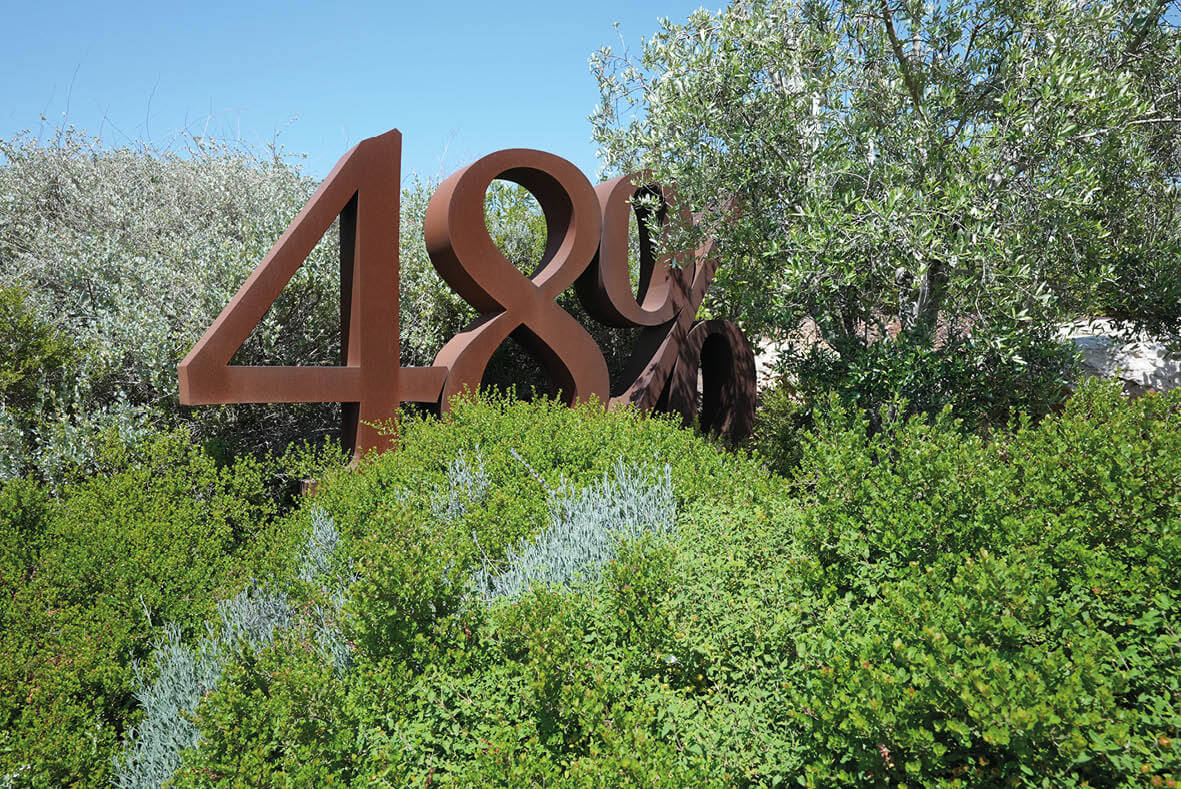
In doing so, the work condemns a colonial logic that seeks to reduce an expansive homeland into decimal fractions, steadily eroded through agreements and walls. The rust that coats these numbers is nothing but the corrosion of souls in exile and the fragmentation of a geography that continues to contract day by day. The question this work poses, in the shadow of the Nakba, is this: How can we imagine a Palestinian existence beyond these numbers? How do we refuse to define ourselves by the scale of loss? In Rabah’s vision, independence begins with confronting these figures, acknowledging their overwhelming presence, and then resisting them in order to open a space that is not bound by percentages, nor confined by maps drawn in blood. It is a refusal to be reduced to a mere ledger of loss.
What if the Nakba is not merely a memory but rather a structure that is continuously produced? From the gnashing of bulldozer arms to the cold tiles of Jaffa’s submerged homes, contemporary Palestinian art grapples with the architecture of loss. Art moves beyond visual luxury and becomes an existential attempt to understand what remains – and an insistence on a presence that defies erasure.
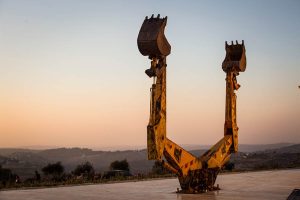
If Rabah’s numbers offer a mathematical description of loss, then Nida Sinnokrot’s KA (Oslo) confronts us with the instrument through which that loss is enacted on the ground. The arms of the Ka excavator do not stand as silent debris, but as a witness that bears the physical scars of an ongoing catastrophe. These JCB 3CX arms, long embedded in our visual memory through scenes of uprooted trees and demolished homes, emerge as the contemporary tools of the Nakba. The excavator is the material force that transforms the house into a tent, a machine that has neither aged nor ceased its work since 1948.
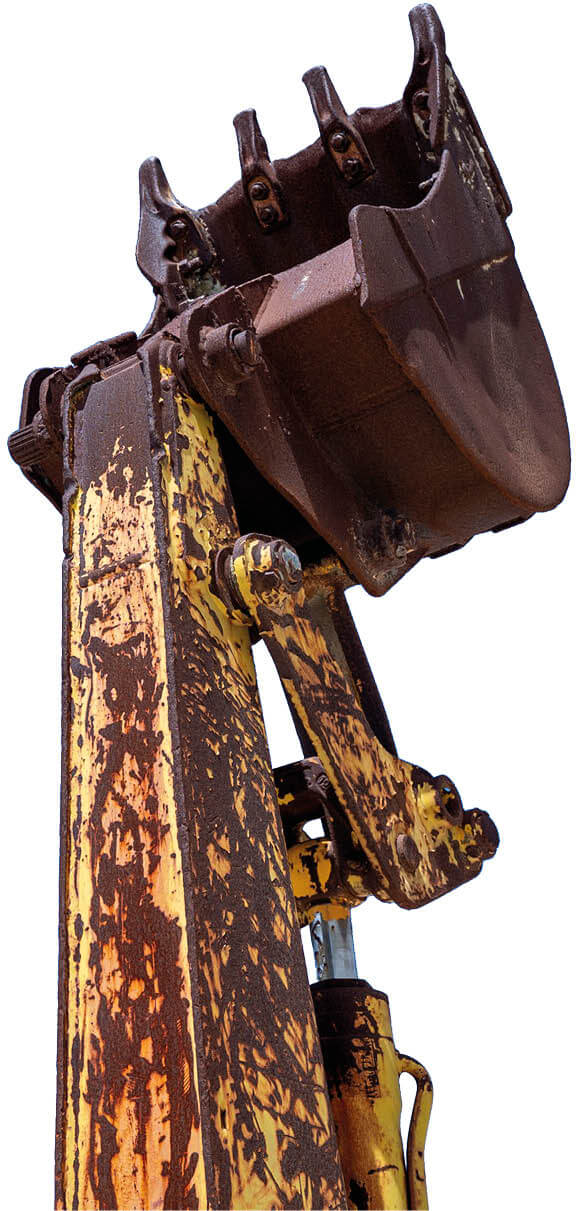
Here, Sinnokrot performs a radical critical act through the inversion of these arms. Suspended in an unstable balance, they are lifted toward the sky in a primal gesture that recalls prayer, surrender at the edge of despair, or perhaps a final cry of resistance. This inversion is an act of purifying the tool from its colonial history. The invocation of the symbol Ka – an ancient Egyptian hieroglyph that symbolizes the life force, both destructive and creative – introduces a stark paradox. The Nakba sought to erase identity by dismantling the physical markers of place, yet the life force itself endures, even within the very instrument of destruction. What emerges is a confrontation with the tool that enacts erasure. The inverted excavator exposes the inability of rubble to bury the story, and suggests the possibility that the machinery of demolition might, through will and artistic intervention, be reimagined as a structure that insists on presence.
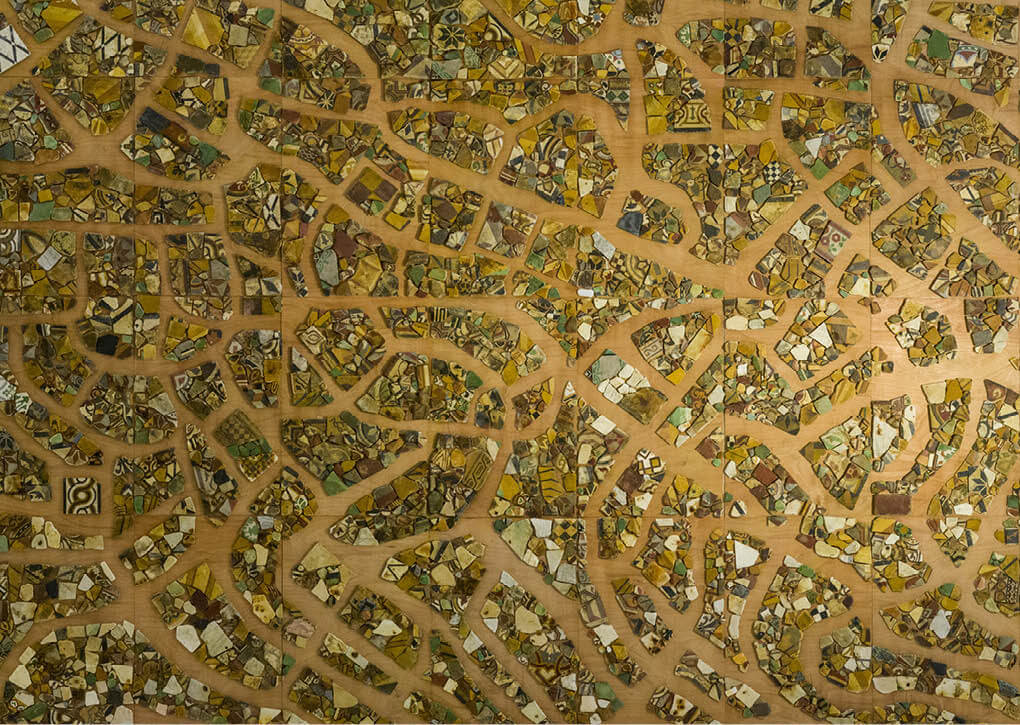
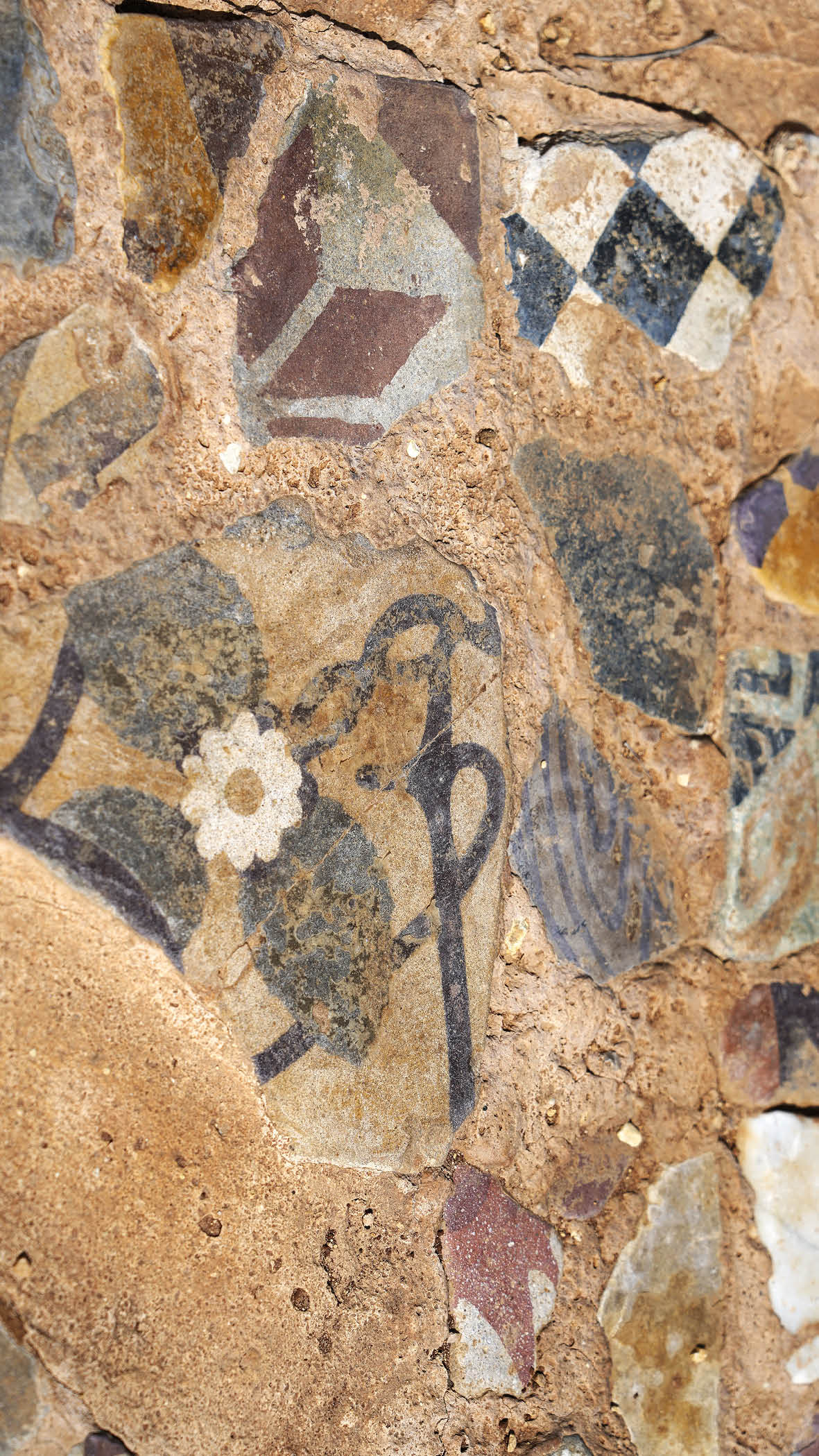
While the arms of excavators worked to dismantle what stood above ground, the sea in Jaffa assumed a different role. In Amir Zuabi’s Cold Floors, the geography of return appears in its most intimate form. Fragments of brightly colored tiles, cold to the touch, are cast back by the waves, remains of homes demolished by Zionist militias in 1948 and discarded into the sea. Collected piece by piece by Zuabi and his son, these tiles carry the imprint of homes that were stripped from their inhabitants and stand as material evidence of the coastal cities that were subjected to systematic ethnic cleansing.
The reassembly of Jaffa’s tiled floors is, in itself, a political act of reclamation par excellence. Each fragment declares a space that once held life, before its inhabitants were forced into exile. What we encounter is a “cold floor,” yet one charged with the warmth of the bodies that once moved across it. In the shadow of the Nakba, Zuabi reminds us that Palestinian memory does not sink. The sea, intended as a grave for our wreckage, becomes instead a custodian, returning what persists. To stand upon this reconstructed surface is to stand at the thresholds of return, a return that begins in the smallest details, in the texture of tiles underfoot, telling us that Jaffa is still capable of gathering its fragments, piece by piece, refusing the logic of erasure.
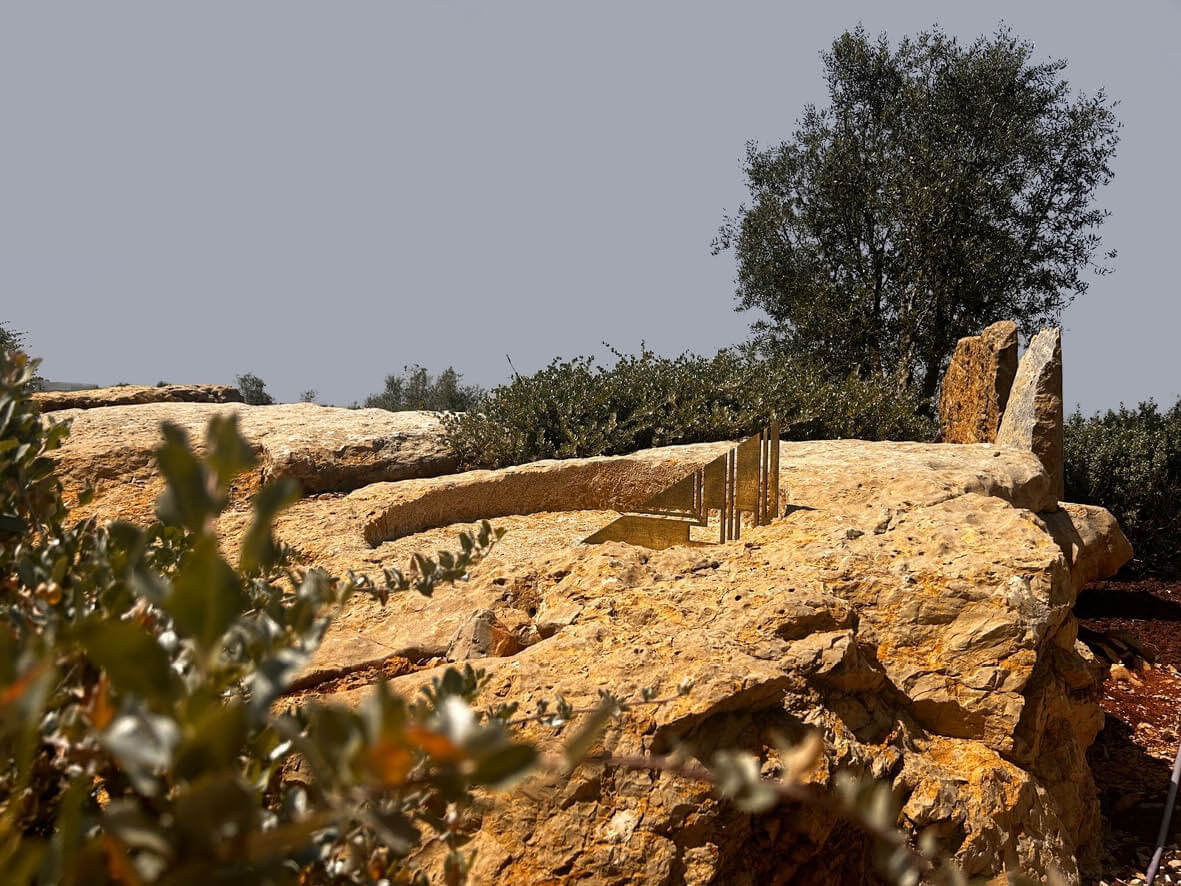
If the Nakba scattered our bodies across distant geographies, it did not unsettle the compass of time within the Palestinian consciousness. In Nisreen and Nermeen Abudail’s work Tareeq Masr (The Road to Egypt), the sundial emerges as an attempt to reclaim Palestinian time. Each piece is oriented northward, toward Palestine, synchronized to a single horizon: return. Unlike other sundials, this particular one, anchored in the gardens of the Palestinian Museum, carries a distinct resonance. It marks a symbolic presence of the artists on their land, its brass gnomons acting as extensions of their own bodies, tilting toward Amman, the city of exile. They appear as two copper petals that are embedded in limestone – an insistence on locating the self within a temporal and spatial frame that exceeds exile.
The work draws on the Tareeq Masr motif, where the language of embroidery shifts from silk threads to an inscription that is carved into material and time. The tilt of the brass gnomon toward Amman resists the idea of exile as a “dead or suspended time.” Time here is neither linear nor lost; it is directional, held in place. Each ray of sunlight that strikes the limestone becomes a daily insistence on the right to exist on this land, a reminder that the routes of displacement remain tethered to the Galilee, Jaffa, and Jerusalem. Within this rhythm, the work calls us to define the self – not as a hostage to a “time passed,” but as a living subject grappling with a “time yet to come,” whose sun will inevitably rise over our reclaimed homes.
What these works reveal is that the Nakba is not a single event that concluded within its year but a reality that we continue to inhabit. It persists within a space that continues to be forcibly reshaped, within the tools that have made destruction habitual, and within the traces that have escaped erasure. It is present in Palestinian time itself, as it resists the political calendar that has been imposed upon it, recalibrating its direction toward its original horizon. From this perspective, art is no longer a medium for viewing but rather a site of confrontation with what has happened and what continues to unfold. It does not soften reality but collides with its naked truth. It is a form of confrontation that does not end at loss but remains with what endures: a trace that refuses to disappear, a direction that refuses to deviate, and a Palestinian presence that continues to assert itself in the world.
Sura Abualrob is the media and communications officer at the Palestinian Museum and a master’s student in integrated digital media at the Arab American University. Her research interests focus on the intersections of the digital sphere, memory, and narrative formations.
