


By Konrad Suder Chatterjee

A child stands in a school courtyard in the West Bank, hesitating before stepping into a circle. Around that child, others are already moving, running, laughing, improvising scenes that seem at first like play. But this is not play as it is commonly understood. It is a structured attempt to release what has no easy language. It is an attempt to return the body to itself.
In Palestine, childhood does not unfold gradually. It is interrupted, accelerated, and repeatedly forced into confrontation with realities it was never meant to hold. Checkpoints precede classrooms, loss precedes language, and fear settles into the ordinary rhythms of life. This condition has been described by the scholar Nadera Shalhoub-Kevorkian as “unchilding”: the political process through which children are systematically stripped of the protections, the meanings, and the temporal space of childhood itself.1
In this framing, childhood is not simply disrupted; it is actively revoked, as children are recast simultaneously as threats to be controlled and lives that can be rendered expendable. The voices emerging from Gaza over the past years make this painfully clear. One young writer reflects: “Every minute during the assault we were afraid and ready to die… we want to live, we want to dream, we want to build our future like other children around the world,” only to ask later, with devastating simplicity: “Aren’t these legitimate rights for us?”2 Within such a context, the question is no longer only how children survive, but how childhood itself can be reclaimed.
Yet within this fractured landscape, spaces continue to emerge where children are not only protected but heard. Among the most sustained of these efforts is the work of ASHTAR Theatre. This Ramallah-based institution has, for more than three decades, positioned theater not as entertainment, but as a cultural, political, and psychosocial necessity.
Theater as psychosocial infrastructure in a context of unchilding and systemic disruption.
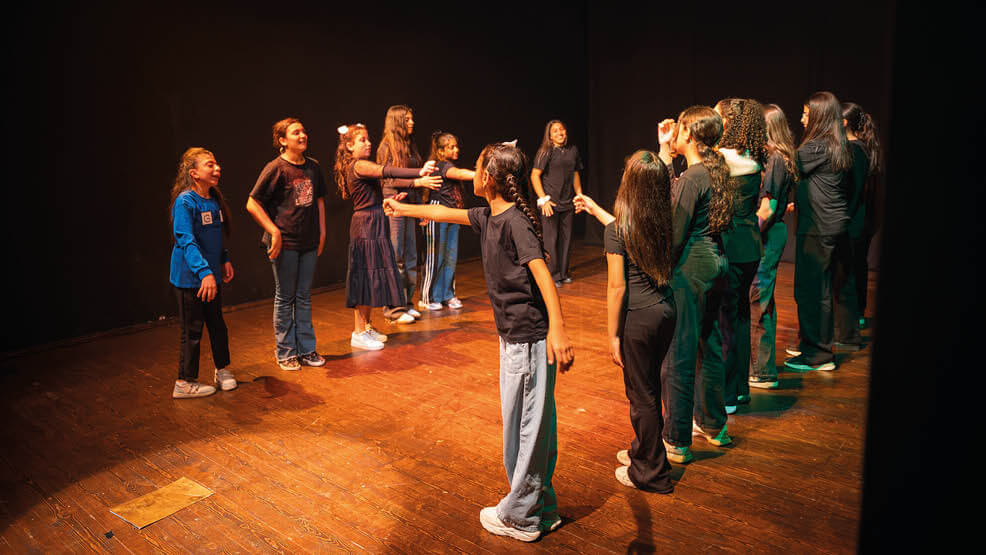
Founded in 1991 by Iman Aoun and Edward Muallem, ASHTAR has evolved into something difficult to categorize. It is at once a theater company, a training institution, a psychosocial intervention actor, and a node within a global network of cultural solidarity. Its work sits at the intersection of art and urgency, responding to a context in which children make up nearly half the population and grow up under conditions widely recognized as incompatible with any notion of a protected childhood.
At the heart of ASHTAR’s philosophy lies a demanding proposition: that theater can serve as a space in which reality, however unbearable, can be processed, reshaped, and rearticulated. In its own framing, theater transforms abstract political conditions into personal narratives that are capable of generating empathy and action. This is not a metaphor. It is a method.
In recent years, particularly following the genocidal war on Gaza and the escalation of violence across the West Bank, not only since late 2023 but also before, ASHTAR’s work has increasingly centered on psychosocial support delivered through theater-based methodologies. Among these, what the organization terms Sport Theatre offers a particularly revealing entry point.
In school courtyards and classrooms, refugee camps and community centers, children gather not around scripts, but around movement. They form circles. They move, compete, improvise, and narrate. Through structured exercises that merge physical activity with theatrical expression, they begin to release what facilitators often describe as “stress held in the body.” The shifts that follow are subtle but profound. One child-participant in a refugee camp in the West Bank reflects: “I felt like I could finally speak; I was someone else, but I was also myself.” Another admits: “I don’t always understand why I’m sad, but it helped to move and play.”3
Teachers report children who had withdrawn beginning to participate; conflicts that once escalated now pause; a child who refuses to speak begins to move, then to laugh, then, sometimes, to lead. These are not transformations that lend themselves easily to measurement, but they are visible. They unfold in posture, in attention, in the willingness to remain in the circle. In environments where daily life is defined by unpredictability, these sessions introduce rhythm, repetition, and something increasingly rare: a sense of contained time.
This work does not present theater as therapy in a clinical sense. Rather, it operates within a broader understanding of psychosocial support, where expression, embodiment, and collective experience become tools for rebuilding internal and social coherence. Since late 2023, ASHTAR’s programs have reached hundreds across the West Bank, Jerusalem, and Gaza, while training teachers and facilitators to sustain this work beyond the lifespan of individual interventions. The emphasis is not only on response, but on continuity, on ensuring that the space does not disappear once it is created.
If ASHTAR’s work begins in intimate circles of children gathered in motion, it extends outward into one of the most significant global cultural mobilizations to emerge from Palestine in recent decades, The Gaza Monologues. Written by young people in Gaza in 2010 and revisited in 2014, these texts have taken on renewed urgency in the present moment. Their continued relevance is not coincidental; it reflects the persistence of the conditions they describe. In response to October 2023 and what followed, ASHTAR issued an international call for artists, institutions, and communities to read and perform these monologues publicly.
The response was immediate and expansive. Across 70 countries, hundreds of groups, ranging from established theater companies to student collectives and independent artists, gathered in theaters, universities, streets, and digital platforms to bring these voices into public space. From Beirut to London and Mumbai, from Madrid to Cape Town and Santiago, the Monologues were read, translated into 25 languages, staged, and shared, crossing not only borders but languages, contexts, and political climates, enabling hundreds of artists and activists worldwide to engage meaningfully in acts of cultural solidarity with Palestinian children. What emerged was not simply a series of performances, but a distributed network of cultural action. Through coordinated digital infrastructures, livestreams, online platforms, and transnational communication channels, ASHTAR facilitated a form of global collaboration in which storytelling became both a medium of solidarity and a mechanism of mobilization.
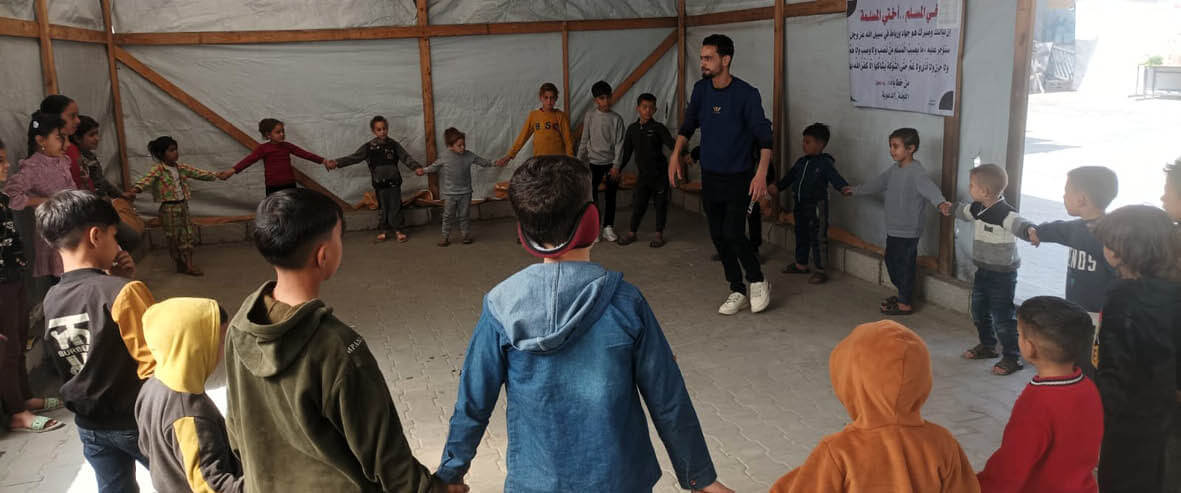
From 2023 onwards, the original Gaza Monologues writers continued to write from within the conditions of war, displacement, and repeated evacuation, their adult voices now accompanying those first articulated in childhood. Some, temporarily relocated to Cairo, have since facilitated workshops with younger children from Gaza, survivors of the ongoing genocide, contributing to the emergence of a new generation of Gaza Monologues.
One writer described Gaza in 2010, tragically relevant from 2023 onwards, as “a plane carrying people… travelling towards the unknown; landing neither in heaven nor in hell.”4 Another writes from within the current war: “We’ve reached a point where you might die, and everyone watches you die… because they are afraid they’ll die with you.”5 These are not metaphors. They are testimonies.
The project has since expanded into a global dialogue, Letters to Gaza, inviting reciprocal communication in the form of poems, messages, and reflections sent from around the world. In this shift from testimony to dialogue, the work extends beyond amplification toward relationship, toward the creation of a shared, if fragile, cultural space. As the introduction states, the project forms “a chorus of voices… that refuse to be silent in the face of injustice.”6 What emerges is not simply performance, but a transnational space where voice circulates, is received, and returns transformed.
It would be a mistake, however, to read ASHTAR’s work only through the lens of intervention. Its artistic production remains central, and it is here that its complexity becomes most visible. Recent works such as Guernica, Gaza: Visions from the Center of the Earth – developed in collaboration with playwrights Naomi Wallace and Ismail Khalidi and directed by Emile Saba, generously supported by the Consulate General of Spain in Jerusalem and AFAC – situate Palestinian experience within a broader artistic and historical lineage. Drawing on Picasso’s Guernica, the production assembles fragmented narratives emerging from war into a layered theatrical form that integrates text, image, and sound, poetically engaging with the dehumanizing slur “human animals.”
At the same time, touring productions such as Oranges and Stones, a nonverbal work built on movement and symbolism, have travelled across Palestine, the region, and Europe, engaging audiences not only through performance but through structured dialogue. Across more than 200 performances, each becomes a site of encounter, where spectators are invited not simply to watch, but to respond.
This dual commitment, to artistic integrity and social intervention, produces an ongoing tension. Theater must remain art, even as it carries the weight of representation, trauma, and expectation. It must allow for ambiguity, even when the surrounding reality offers little. Yet this work unfolds under pressure. As one Gazan testimony recounts, “I used to hold children’s hands and play with them on stage, not carry their missing parts.”7
Underlying both the psychosocial and artistic dimensions of ASHTAR’s work is a long-term investment in training. This investment in training addresses a wider structural gap. A recent feasibility study found that more than half of young Palestinians surveyed considered existing training opportunities in the performing arts insufficient, while 56 percent viewed university-level offerings in the field as inadequate.8 Drawing on diverse methodologies, including the practices of Augusto Boal’s Theatre of the Oppressed, which ASHTAR had pioneered and popularized in the Arab world, as well as traditions associated with Stanislavski and physical theater, participants are not only taught how to perform, but how to facilitate, analyze, and lead.
This model is cumulative. Children become youth participants; youth become facilitators; facilitators become trainers, with trajectories such as that of Emile Saba, now ASHTAR’s artistic director, who began as a young participant in its training programs. In this way, ASHTAR functions as a parallel educational system, one that cultivates both artistic skill and social agency.
In a context where Palestinian children are systematically denied the conditions of childhood, theater emerges as more than an art form. Through its psychosocial programs and global initiatives such as The Gaza Monologues, ASHTAR Theatre has developed a model that bridges trauma, expression, and collective resilience, raising urgent questions about what it means to reclaim childhood under conditions of ongoing genocide, dispossession, and ethnic cleansing.
The issue is not an absence of interest. The same study found that while long-term commitment remains difficult under present economic and social conditions, nearly 90 percent of interested youth were willing to engage in shorter-term performing arts training, suggesting that the challenge is less desire than access, continuity, and institutional support.
The development of a Performing Arts Academy and Village in Birzeit, in partnership with the Palestinian Circus, reflects this ambition at an institutional level.9 It signals a shift from program-based work toward long-term cultural infrastructure: a space where theater and circus can be taught, practiced, and sustained as disciplines that are rooted in Palestinian experience.
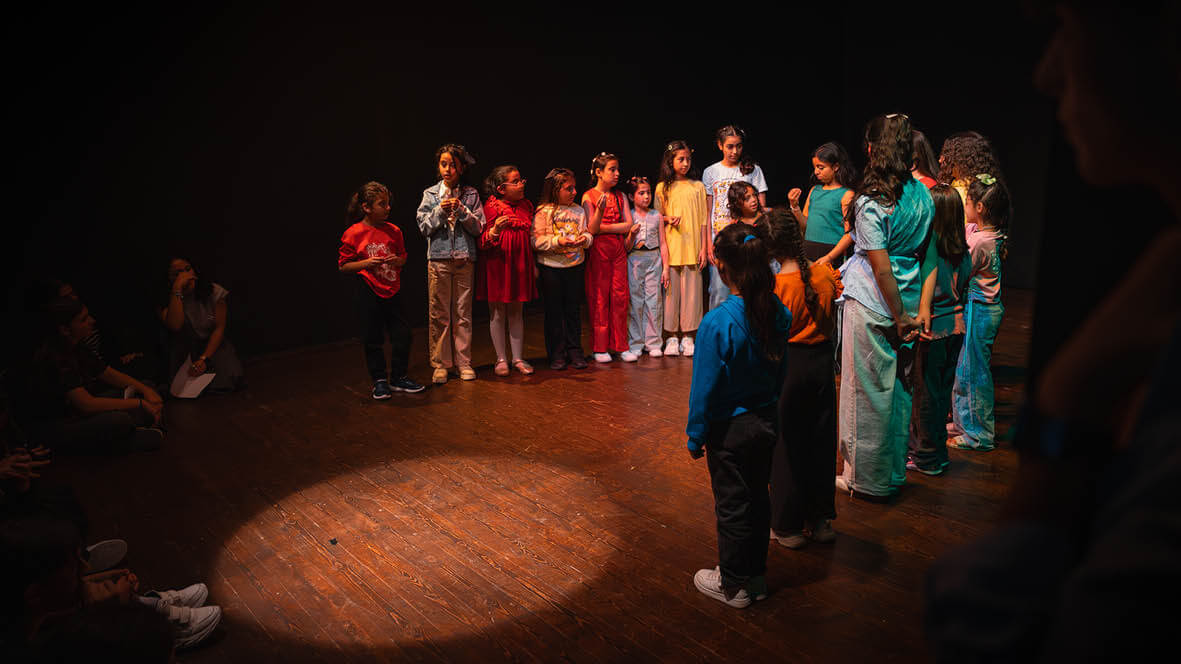
To understand ASHTAR’s work fully is to recognize the conditions under which it operates. Financial precarity, movement restrictions, and the pressures of responding to the ongoing conditions of fragmentation and crisis shape both the scope and the limits of what is possible. One-off funding enables expansion; sustained support enables continuity. The difference is not administrative; it is experiential, determining whether a child encounters a single intervention or an ongoing space of return. There is also a quieter tension: between the need to represent trauma and the risk of reproducing it; between amplifying voices and protecting them from instrumentalization. ASHTAR’s work moves within this tension, attempting to create spaces where expression does not become extraction. What emerges from ASHTAR’s practice is not easily defined. It is not solely theater, nor solely education, nor solely psychosocial support. It is a liberatory system that operates across these domains, intersecting them, translating between them, with children at the center of its focus.
This work also unfolds within a limited national cultural infrastructure. A recent study counted only 17 operating theaters across Palestine,10 a reminder that institutions such as ASHTAR do not function against a backdrop of abundance, but within a field marked by scarcity, fragility, and uneven access. At a local level, it creates spaces where children can move, speak, and begin to process their realities. At a national level, it contributes to a cultural landscape in which art remains a site of resistance and expression. At a global level, it activates networks through which Palestinian voices circulate, resonate, and return.
In the context of this issue, dedicated to nurturing and defending Palestine’s children, ASHTAR’s work offers both a case study and a challenge. It asks what it means to invest not only in survival, but in expression; not only in protection, but in participation. If childhood in Palestine is marked by interruption, then the work of institutions such as ASHTAR lies in creating forms of continuity, however temporary, however fragile, within which children can reclaim something of what has been taken from them. Not as an abstraction, but as a sustained practice over more than three decades.
Article photos courtesy of ASHTAR.
1 Nadera Shalhoub-Kevorkian, Incarcerated Childhood and the Politics of Unchilding, Cambridge University Press, 2019.
2 Ala’ Hajjaj, The Gaza Monologues 2014, English, ASHTAR Theatre, 2014.
3 Konrad Suder Chatterjee, Mental Health and Psycho-Social Support through Theatre in Palestine: An Initial Report of the MHPSS Programme since October 2023, ASHTAR Theatre, 2025.
4 Amanee A Shorafa, The Gaza Monologues 2010, English, ASHTAR Theatre, 2010.
5 Ahmad Taha, The Gaza Monologues 2024, English, ASHTAR Theatre, 2024.
6 Letters to Gaza, 2024, Introduction, ASHTAR Theatre, 2025.
7 Amjad Abu Yasin, The Gaza Monologues 2024, English, ASHTAR Theatre, 2024.
8 Arab World for Research and Development (AWRAD), Economic, Cultural, and Social Feasibility Study for the “Performing Arts Village in the Jordan Valley” Project, AWRAD, 2023, prepared for ASHTAR Theatre and the Palestinian Circus.
9 ASHTAR Theatre, Performing Arts Academy and Village in Birzeit, Palestine, ASHTAR Theatre & Palestinian Circus School, YouTube video, uploaded October 25, 2025.
10 AWRAD, Feasibility Study for the “Performing Arts Village in the Jordan Valley,” 2023.
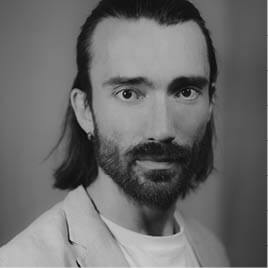
Konrad Suder Chatterjee is a Polish-Czech cultural practitioner, educator, classics teacher, and researcher in the political economy of violence, focusing on childhood, theater, poetry, and creative practice in contexts of conflict, trauma, and collective resilience. He has served as communications manager and resource developer for ASHTAR Theatre in Ramallah since 2024.
