


Raniah Amodi
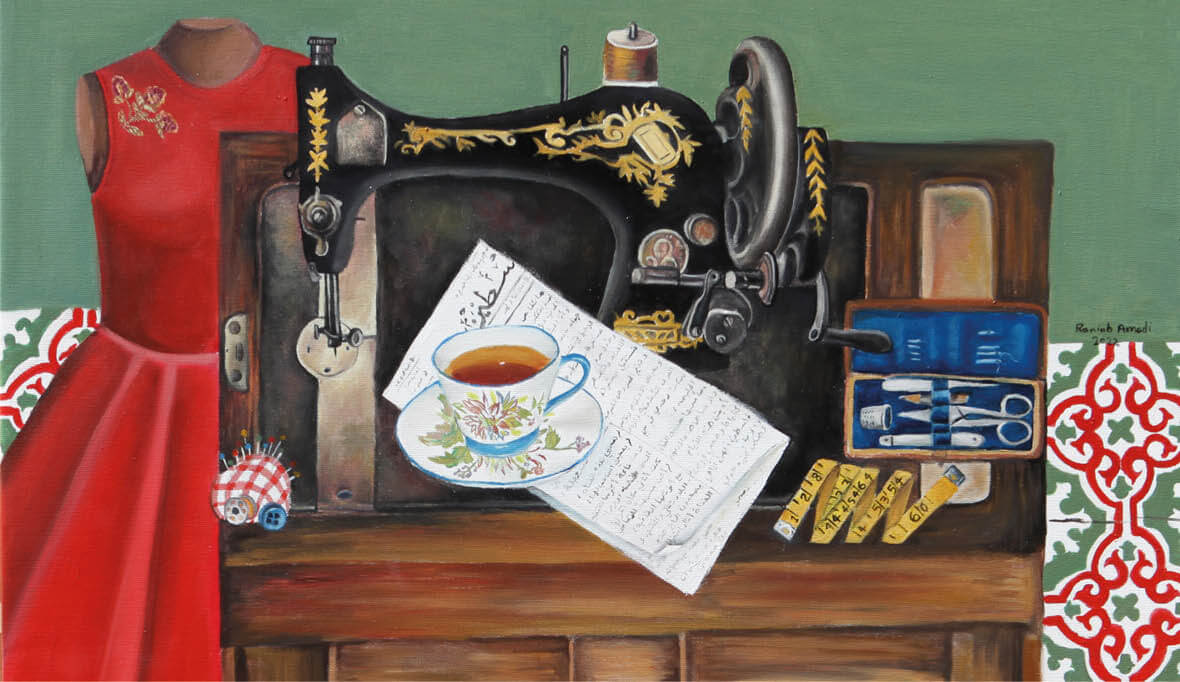
Raniah Amodi was born in to Palestinian parents in Riyadh, Saudi Arabia. She started drawing at a very young age, even before she learned to write, and at the age of five, completed her first mural, which astonished her family but was nevertheless not considered a significant achievement. She received her schooling in a strict, conservative environment that focused on science and academic subjects, while art was seen as merely a form of entertainment. Young Raniah’s interest was less in academic studies, and she was more inclined to draw and fill her notebooks with sketches, frequently living in her own world during class, for which she was criticized and punished – even in art classes, where teachers did not believe that the works she submitted were her own. “So despite my early passion for art, I did not receive much support or encouragement to develop my talent at the time,” she recalls. However, this lack of recognition did not keep Raniah from persevering, as she considers art her fundamental means of expression and communication.

Leaving her family behind, Raniah moved to Palestine to study fine arts at An-Najah National University in Nablus, where she excelled in her studies. Having initially traveled regularly between Palestine and Saudi Arabia to renew her residency, Raniah in her final year decided to give up her Saudi residency and settled in Palestine to continue her artistic and professional career.
Women occupy a central position in her work. They tend to be depicted in simple, practical, feminine clothing or in garments that feature traditional patterns, without extravagance. The sharp folds in these garments resemble crystal formations, signifying protection, while their flow remains restrained, much like life itself. Cats appear as another recurring element in Raniah’s work. Symbolizing the stability she lacked in her life, they are cats of courtyards and homes. Her displacement during childhood, followed by her settling in Palestine, with all its complexities, led her to question the meaning of stability, a condition she finds only in her paintings.

Tiles have been a basic feature in Raniah’s work. She explains that this stems from her conservative upbringing, when walking modestly and lowering her gaze was seen as a sign of adherence to societal norms and the conservative religious culture. This imbued her visual memory with images of tiles, patterns, and floors, which she transformed into a visual stage for her work upon which events, elements, and themes take shape. Each detail carries a carefully considered geometric symbolism that supports the overall concept and forms the basis for the other elements. More recently, Raniah has begun to incorporate pieces of jewelry, often from her own collection, to represent women’s inner wealth. Her themes tend to spring from her imagination and frequently reflect real-life experiences.

Raniah has held numerous solo exhibitions both locally and regionally. She has participated in group exhibitions at Sharjah Cultural Center in Abu Dhabi, at Roger Gallery in New Orleans, Louisiana, the Cairo Amman Bank Symposium, the 9th Fine Arts Exhibition in Beirut, Lebanon, the Alexandria Symposium in Egypt, and the group exhibition “Jordan in Our Eyes” in Amman Jordan. She currently serves as head of the Department of Fine and Expressive Arts at the Palestinian Ministry of Education and conducts art training for students at several cultural centers.
