


Courtesy of UN Human Rights Office in the Occupied Palestinian Territory
Yasmeen is a 27-year-old woman from Gaza City. She told the UN Human Rights Office in the Occupied Palestinian Territory (OHCHR OPT) about her story of survival and her work to advance children’s right to education against formidable odds.
“I used to love my life. I lived in a beautiful home with my family; I had a job and volunteered everywhere. I got engaged. My life felt stable. I was grateful. Before the war, I used to think about the future. Make plans. This is over now. We thought this was going to be like other wars: heavy, painful, terrifying, but survivable. By the third day, it was clear this time was different. The bombing was insane. The internet was shut down. People were shouting in the streets, telling us to evacuate because the army was advancing.
“We refused to leave Gaza City. We made the decision to stay together under one roof. My grandfather’s household of four families all stayed in two three-floor buildings with a shared courtyard. We were besieged three times. One siege lasted 21 days, with Israeli tanks stationed two minutes away from the house. We hid on the ground floor so that the soldiers could not see signs of life. The building next to us was bombed, and the rubble collapsed onto my grandfather’s house. There were no injuries, but every service was cut off: water, electricity, everything. There was water in old basement tanks, filthy and not fit for drinking, but it kept us alive. Food was rationed to one piece of bread per day. After the siege, we cleaned the rubble and stayed. We survived two more encirclements, including one during Ramadan.

“Six months into the war, I realized I could no longer live paralyzed like that. A colleague from the Social Development Forum (SDF),* where I had volunteered during the COVID-19 crisis, reached out. They needed a field coordinator for an emergency education project in northern Gaza. Despite the risks, I accepted without hesitation. My family begged me not to go. My mother was terrified. But I needed to reclaim some purpose, something stronger than fear.
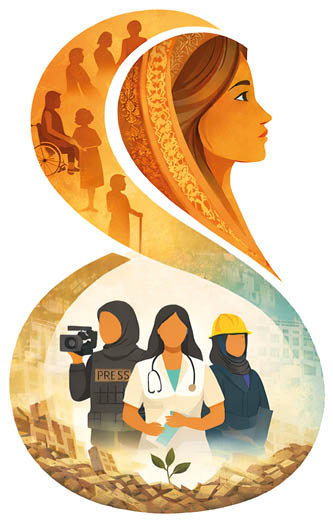
On International Women’s Day, the offices of UN Human Rights, UN Women, and the United Nations Population Fund in Palestine launch the “We Survive, We Lead” campaign to amplify the lived experiences of Palestinian women. In partnership with Taawon (Welfare Association), we present stories of suffering, resilience, and leadership as a testimony and a clear call to action to uphold and protect dignity and human rights.
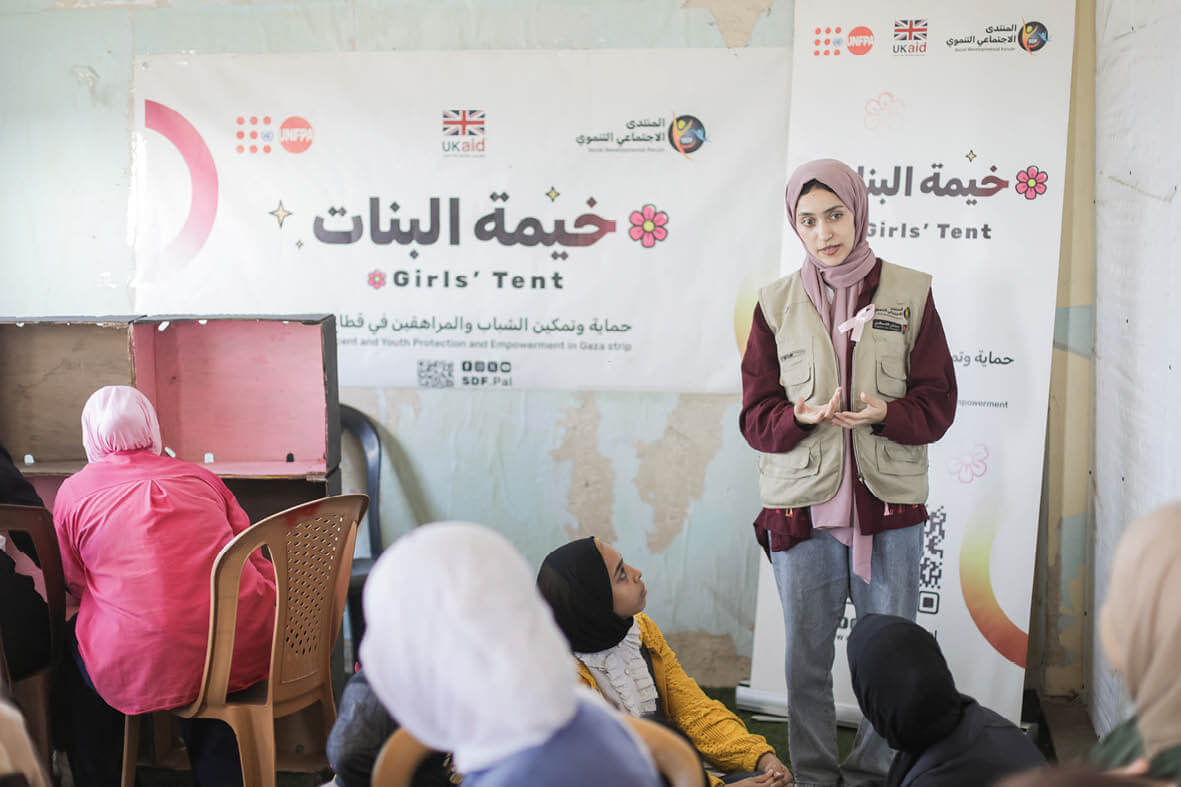
“Our team had only three people. We searched for safe areas – ‘safe’ only by Gaza standards. We created educational spaces for children, sometimes in old schools, sometimes in family homes, sometimes using nothing more than a tent that became unbearably hot during the day.
“The situation was so miserable that we had to weigh rights against each other: the right to life, the right to shelter, the right to education. When the spaces we used were needed to shelter newly displaced families, we vacated. We escorted children to and from the educational spaces as if we could protect them from airstrikes. We tried.
“There were no bathrooms for children, no proper classrooms or equipment, and constant danger. But the children laughed there. They played. They learned. They felt human again. I was proud.
“Eventually, I transitioned to coordinating a UNFPA-funded project serving youth, adolescents, and women. I ran spaces for women and girls that offered reproductive health services, psychosocial support, and safe learning hubs. Today, I manage a team of 12 members.
“The war changed me. I am more stubborn now, and somehow more hopeful. I do not know what I will choose. But I insist on choosing. It is my right. Thinking about the future now feels like trying to see through fog. But here is what I know with certainty: I love my home; I love Gaza. I loved it before the war, and I love it now. I am not scared by its streets, and my love is not erased by its scars and mounting rubble.”
*The Social Developmental Forum (SDF) is a Palestinian NGO focused on fostering youth leadership in sustainable development. SDF is partners with the UN Human Rights Office in the Occupied Palestinian Territory (OHCHR OPT).
