


By Sari Taha
For decades, Palestine has watched its brightest minds board planes to Silicon Valley, London, and Dubai. The narrative has always been the same: Talented engineers must leave to succeed. But what if this story is changing? What if the path to economic resilience doesn’t run through emigration but through a different kind of connection, one that allows Palestinian engineers to build world-class technology from Ramallah, Nablus, and Gaza, serving global clients while remaining rooted in their communities?

At the end of 2025, a team at Momentum Labs was commissioned by Palestine Techno Park to develop a structured, practical investment guide. This work was undertaken in support of Techno Park’s strategic Palestine Diaspora Network for Technology, an initiative established two years ago to strengthen the bridge between Palestinian professionals abroad and the thriving tech sector at home. The comprehensive guide the team produced is designed to help diaspora businesses navigate investment opportunities in Palestine’s technology sector, framing it not as an act of charity but as a sound strategic decision that is backed by proven track records and exceptional talent. The guide will be made publicly available following its official launch by Palestine Techno Park.
This is a call to the global Palestinian community: Diaspora-led investment in Palestinian tech talent can reverse brain drain and build economic resilience.
Quality speaks for itself: When Husam Barqawi founded Infinite Tiers Group (ITG) in Ohio, he needed a software development team capable of serving Fortune 500 clients. He evaluated options across the globe: India, Eastern Europe, Latin America. But in 2006, he made a decision that would define his company’s success: He established his core engineering team in Nablus, Palestine. “When we compared locations, Palestine stood out not for low costs but for unmatched quality,” Barqawi explains. “A single Palestinian engineer often delivers what takes two or three elsewhere.”1 This isn’t marketing rhetoric. Today, ITG employs over 250 engineers in Palestine, making a substantial multimillion dollar annual contribution to the local economy in the form of salaries and employee benefits.2 Despite every external challenge imaginable, the Palestine team has maintained a perfect record of on-time delivery for the company’s most demanding clients. This is the proof: Palestinian engineers don’t just meet global standards, they often exceed them.
The same pattern emerges across multiple success stories. When NVIDIA acquired Mellanox in 2020, they made a landmark decision: directly hire the 150 Palestinian engineers who had been supporting their projects.3 Silicon Valley’s most demanding chip company chose to establish its first direct employment footprint in Palestine. Why? Because the talent was undeniable.
The examples above are archetype incidents that have changed everything. But there’s something more profound happening here than just technical excellence. Palestinian engineers possess a unique characteristic that distinguishes them in the global marketplace: When given genuine opportunity, they choose to stay. Mohammad Asseedeh, offshore operations manager at Xngage, oversees a team of 70 engineers in Nablus who form the core of the company’s delivery engine for enterprise e-commerce solutions. “Palestinian teams deliver US-level expertise at a fraction of the cost, not as low-cost labor, but as high-value partners,” he notes.4 But the real value isn’t just the work they deliver. It’s their commitment to staying.
This is the archetype that other markets cannot replicate: engineers who possess world-class skills but are deeply rooted in place, family, and community. They’re not looking for the next opportunity to relocate to San Francisco. They want to build their careers, raise their families, and contribute to their society, from home. This changes the entire equation. While companies in Bangalore and Bucharest struggle with 30–40 percent annual turnover as engineers jump to better opportunities, Palestinian teams demonstrate remarkable stability. They’re invested, literally and emotionally, in the success of their partnerships because these partnerships represent something larger: the ability to thrive without leaving.Here’s where the conversation needs to shift. For too long, offshoring has been framed around cost arbitrage: finding cheaper alternatives to Western talent. This framework is not only condescending, it fundamentally misunderstands what Palestinian engineers offer. The Palestinian diaspora, 7.8 million strong globally, has a choice to make.5 You can view Palestinian engineers as a way to cut costs, or you can recognize them for what they truly are: strategic assets with global-caliber skills and an unparalleled commitment to excellence.
Moving from cost-cutting to strategic partnership, firms have begun to consider Palestinian employees as strategic assets with global-caliber skills and an unparalleled commitment to excellence.
When ITG’s Barqawi chose Palestine, he wasn’t looking for the cheapest option. He was looking for the best. When Xngage built their core team in Nablus, it wasn’t to save money on junior developers. It was because Palestinian engineers could handle their most complex challenges. This distinction matters because it transforms the relationship from transactional to transformational. When you hire Palestinian engineers for their quality, you’re not doing charity. You’re making a sound business decision that happens to have profound economic and social impact. You’re creating jobs that allow talented people to stay in their homeland. You’re building teams that will remain loyal and committed because they’re exactly where they want to be.
Let’s be clear: This is not a call for charity. It’s a call for recognition and strategic action. Recognizing the opportunities from which they benefitted, successful Palestinian diaspora professionals should consider it their duty to provide, through remote collaboration, similar opportunities to their equally talented cousins, classmates, and community members back home.
The global Palestinian community, particularly those who have succeeded in tech hubs from Boston to Berlin, has a duty to strengthen the linkage between the Palestinian technology sector and the global economy. Not because Palestinian engineers need help, but because they deserve the opportunities that their skills warrant.
Every diaspora professional who has built a career at Google, Microsoft, Amazon, or any tech company has benefited from opportunities that were available to them. Those same opportunities should be available to their equally talented cousins, classmates, and community members in Palestine, not through relocation, but through remote collaboration that leverages Palestine’s strategic time zone (UTC+2/+3), robust infrastructure, and proven delivery record.

The foundation for online employment is ready and the infrastructure is firmly in place. State-of-the-art facilities exist not only at Palestine Techno Park next to Birzeit University but also at locations such as Rawabi Tech Hub and within modern commercial buildings across Ramallah and other major Palestinian cities.6 The ecosystem is supported by the Palestinian Information Technology Association (PITA), which represents over 200 major ICT companies and serves as the primary advocacy body for the sector.7 Innovation hubs across Ramallah, Nablus, Hebron, and other cities, including Gaza Sky Geeks, Intersect Innovation Hub, and Flow Accelerator, offer coworking spaces, training programs, and startup incubation. Annually, Palestinian universities produce over 8,000 STEM graduates,8 while fiber-optic broadband reaches speeds up to 300 Mbps in urban centers.9 Supportive legal frameworks protect foreign investment, and tax incentives reward job creation.
The ground is fertile. What’s needed now is the water: the diaspora capital, connections, and commitment that can transform potential into prosperity. This constitutes a different kind of return. For Palestinian diaspora professionals, there are many ways to “return” to Palestine. Physical relocation isn’t the only option, and for many, it isn’t realistic. But there’s another kind of return, one that might be even more powerful: bringing opportunities back. When you hire a team in Ramallah to build your company’s next product, you’re returning. When you invest in a Palestinian startup, you’re returning. When you connect a Palestinian firm to clients in your network, you’re returning. When you mentor engineers in Nablus via video call, you’re returning. This is the return that builds economic resilience. This is the return that creates jobs at scale. This is the return that allows the next generation of Palestinian talent to choose home.
For those ready to take action, navigating the Palestinian tech ecosystem doesn’t have to be complex. Whether you’re a diaspora professional exploring your first investment, a tech company considering offshoring, or an entrepreneur seeking strategic partnerships, there are clear pathways to engagement. Working in partnership with Palestine Techno Park, organizations such as Momentum Labs provide strategic guidance to help international investors and diaspora professionals connect with Palestine’s technology sector through structured engagement models (see graphic).
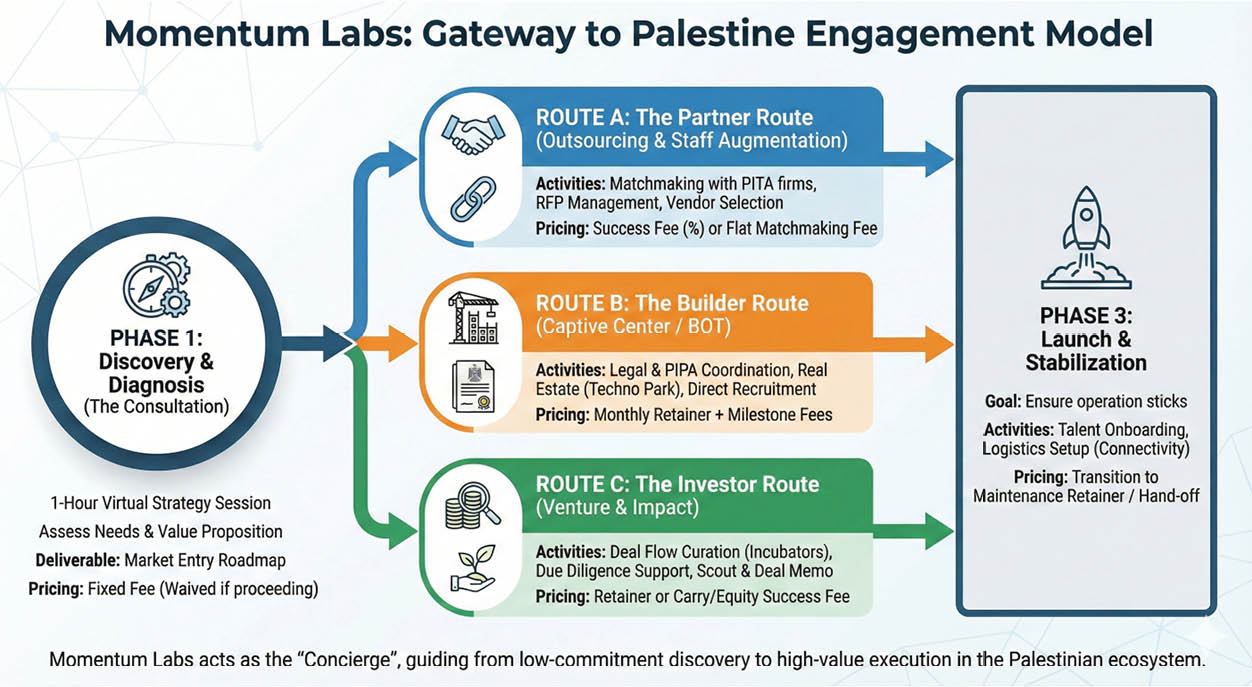
The journey typically begins with a discovery consultation to assess goals and determine the best fit, whether that’s partnering with established Palestinian IT firms for outsourcing, building one’s own development center, or investing in promising startups. From there, tailored support helps navigate everything from legal registration and PIPA incentives to talent recruitment and ecosystem integration.
For anyone interested in exploring these opportunities, resources and guidance are available. The goal is simple: to make it as straightforward as possible for those who want to invest in Palestinian talent to do so successfully. This isn’t about convincing anyone; the track record speaks for itself. It’s about ensuring that those who are ready to engage have the support they need to succeed.
While the practical pathways forward are surprisingly simple, the impact of such a shift would be transformative:
– 13,500+ ICT professionals currently in Palestine could triple their earning potential without leaving home;10
– 2,260+ ICT graduates annually could enter a thriving market instead of joining emigration queues;11
– $500+ million in annual tech sector value-added could multiply several times over;12
Families stay together. Communities remain intact. Brain drain becomes brain retention.
Thus, we call on the Palestinian diaspora in tech: You have the power to change the equation. Your companies are hiring engineers. Your networks are vast. Your credibility opens doors. The question is: Will you look to Bangalore and Bucharest first, or will you look home?
To international tech leaders, we call: Palestinian engineers are not a charitable cause; they’re a competitive advantage. Proven. Reliable. Exceptional. Ready to partner.
To Palestinian engineers, we call: Your choice to stay is not a limitation; it’s your strength. The world is learning what diaspora leaders already know: You’re among the best in the world. And now, increasingly, the world is coming to you.
The digital horizon is vast, and Palestine’s position within it is strengthening. The infrastructure is built. The talent is proven. The ecosystem is maturing. What we need now is the bridge: diaspora-led partnerships that recognize Palestinian engineers not as beneficiaries of support, but as strategic partners in building the future.
Brain drain is not inevitable. It’s a choice. And increasingly, when given the right opportunities, Palestinian engineers are making a different choice: to build the future from home.
This article draws from research conducted for the “Building Global Teams from Palestine” guide, developed by Palestine Techno Park’s Diaspora Network for Technology as a comprehensive resource for investors and diaspora professionals who are exploring partnerships with Palestine’s ICT sector. For more information, visit Palestine Techno Park at www.technopark.ps or contact Momentum Labs at info@momentumlabs.me
1 Interview excerpt, “Building Global Teams from Palestine” investment guide, Palestine Techno Park, 2026.
2 Ibid.
3 “Case study: NVIDIA direct employment,” “Building Global Teams from Palestine” investment guide, Palestine Techno Park, 2026.
4 Interview excerpt, “Building Global Teams from Palestine” investment guide, Palestine Techno Park, 2026.
5 “8 Billion People, Infinite Possibilities: A Matter of Rights and Responsibilities,” Palestinian Central Bureau of Statistics, World Population Day 2025.
6 “Who We Are,” Palestine Techno Park, 2025.
7 “About PITA,” Palestinian Information Technology Association (PITA), 2025.
8“Building Global Teams from Palestine” investment guide, Palestine Techno Park, 2026.
9 Ibid.
10 Palestinian Central Bureau of Statistics. (2025). ICT Sector Statistics, available at https://www.pcbs.gov.ps.
11 Ibid.
12 Ibid.
 Sari Taha is a co-founder and managing partner at Momentum Labs, a boutique consultancy firm and a startup studio operating at the intersection of business, technology, and social impact. He is an entrepreneurship and technology sector expert who has been working toward the development of the entrepreneurship ecosystem and the private sector in Palestine for the past 10+ years in multiple roles and capacities with the private and public sectors and international organizations. Sari holds a BSc in mechanical engineering from Birzeit University and an MBA with a focus on technology management from Technion – Israel Institute of Technology.
