


By Ali Qleibo
The study of Jerusalem and the broader land of Palestine presents a complex historiographical challenge, largely because narratives of history are rarely neutral. As often noted, “the victor will always be the judge and the vanquished the accused,” a dynamic that permeates the contentious Israeli-Palestinian struggle over history and sovereignty. The history of the region is not a single, linear progression but a complex tapestry woven from archaeological findings, linguistic evolution, religious beliefs, and political agendas. Competing interpretations of the past, whether rooted in biblical prophecy, Islamic theology, or modern political identity, vie for primacy, underscoring the necessity of a nuanced academic approach that acknowledges the fluidity of identity and the subjective nature of historical truth.
Archaeological evidence corroborates the city’s ancient importance, pushing the timeline of the first human settlement near the Spring of Silwan to between 4500 and 3500 BCE. The discovery of massive Canaanite defensive walls from the seventeenth century BCE – featuring multi-ton boulders that stand eight meters high – attests to the sophistication and strategic significance of the early city. These ancient structures stand as physical testaments to a history often overshadowed by later biblical narratives.
From the outset, revisionist biblical historiography codified the demographic expansion of the nomadic tribes into the land of Canaan in geopolitical terms. As the enemies of Yahweh, these nations, perceived as antagonists, had to be defeated, their gods conquered, abolished, and – in the case of the indomitable Edomites – converted. The Bible recounts the battles waged by the people of Yahweh and the corollary massacres against the Canaanite tribes and their descendants who were satanized, dehumanized, and objectified into their nemesis.
The history of Jerusalem is a chronicle of continuous human settlement and shifting cultural identities spanning six millennia. An examination of key historical events, linguistic origins, and archaeological findings reveals the complex narrative of a city whose very essence is defined by overlapping claims to sanctity. The name of the city itself mirrors its layered history, evolving from the earliest Canaanite appellation, Ur Salem (“city where the god Salem dwells”), through Jebus and the Roman Aelia Capitolina, to the current Arabic Al-Quds (“The Holy”).
The very name of the city, Ur Salem, denotes its Canaanite origins and the continuity of its sacred identity. Derived from two Canaanite words – Ur meaning city, and Salem (Shalim) referring to the Canaanite god of dusk or peace – the name has evolved over five millennia to mirror the changing cultures, religions, languages, and dialects that have held sway. From its earliest Canaanite name Ur Salem, the city where the god Salem dwells, Jerusalem’s name, passing through Jebus to the Roman Aelia Capitolina to Al-Quds, has reflected the tribulations of time, of war and of peace, of ideals and hopes of salvation throughout its history. “Salem,” “Saleem,” “Salam,” and “Salameh” are popular male Arabic names that derive from the consonantal Arabic root S-L-M, among which the name Salam features in the Qur’an as one of the 99 names of Allah. “Salam” as an epithet of God denotes the state of divine purity, immaculateness, intactness (flawlessness), completion, integrity, and perfection, i.e., a totality that connotes wholeness, which is an irreducible quality of Allah.
From the earliest hieroglyphic mention of Jerusalem as Rusalimum in the Amarna texts of the fourteenth century BCE, to the Roman Aelia Capitolina and the current Arabic Al-Quds, the name traces a deep historical trajectory. The etymological connection to the Semitic root S-L-M extends into the Abrahamic faiths in profound ways, denoting divine purity, perfection, and wholeness. This linguistic thread suggests a foundational, shared spiritual legacy that transcends specific religious doctrines and anchors the city’s identity in the concept of divine peace and holiness (Al-Quds).

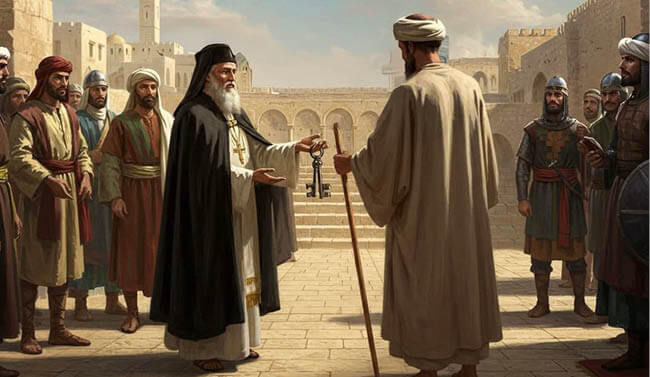
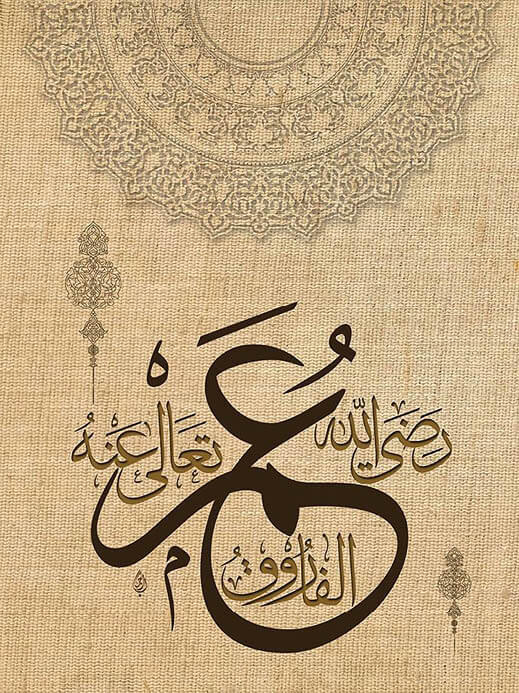
The Muslim army’s entry into Jerusalem under the Arab Caliph Omar ibn Al-Khattab in the seventh century CE, and his welcome by the Aramaic-speaking Banu Ghassan, Banu Lackm, Nabatean, and Christian Arab tribes who lived there together with diverse ethnic Christian minorities offers a critical case study in how historic events are codified. The event is commonly translated as the “conquest” of Jerusalem, but the original Arabic term used is fath (فتح), which carries a connotation better captured by “opening,” “liberation,” or “unveiling.” This linguistic distinction is crucial to understanding the Islamic perspective on the event, whereby in 638 CE, the Islamic Caliphate expanded its territory to include Jerusalem under its hegemony. Caliph Omar ibn al-Khattab signed a treaty with the Christian Patriarch of Jerusalem, Sophronius, assuring him that Jerusalem’s Christian holy sites and population would be protected under Muslim rule. Christian Arab tradition records that when Omar was led to pray at the Church of the Holy Sepulcher, one of the holiest sites for Christians, he refused to pray inside the church so that Muslims would not request that it be converted into a mosque. Instead, he prayed outside, at the location of the Mosque of Omar, which still stands today, opposite the entrance to the church. Furthermore, he welcomed the Jews back into Al-Quds.

The Muslim acquisition of Jerusalem under Caliph Omar ibn Al-Khattab around 637–638 CE provides a pivotal example of how historical events are framed through specific cultural lenses. As the event is described in Arabic as a fath, “opening” or “liberation,” rather than merely “conquest,” from an Islamic perspective, this was not an occupation but the re-establishment of a city central to their faith under a just rule that guaranteed the security and religious freedom of the Christian residents through the “Covenant of Omar.”
The core of Jerusalem’s Muslim Arab identity is found in the ancient Semitic root S-L-M. While Salem referred to the Canaanite god of dusk, the same root underpins the Arabic word salam (peace), an epithet for Allah that denotes divine wholeness and perfection. This linguistic continuity underscores an unbroken thread of spiritual significance tied to the city’s fundamental identity as an abode of holiness, which finds its teleological Muslim appellation of Jerusalem as Beit al-Maqdis.
The narrative surrounding the fath contrasts sharply with the perspective that biblical historiography has imposed on the land. The biblical narrative is often presented as a geopolitical framework that justified the early Israelite expansion into Canaan by casting Indigenous populations such as the Canaanites and Edomites as “enemies of Yahweh.” This victor’s history, the argument goes, became the foundational lens through which subsequent generations of biblical and Western scholars have interpreted the ancient history of the Levant, solidifying a biased historical perspective that frames modern land disputes.
Indeed, the ethnic reality of the region has always been fluid and complex. The Edomites, for instance, after a period of intensive Hellenization, as evident in Bet Gibrin and Askalan, had been absorbed by the Nabateans through marriage and language and dissolved as a distinct ethnic cultural group long before the Byzantine period (fourth to seventh centuries CE), having been fully absorbed by the Nabateans who had superseded them. This integration is exemplified by Herod the Great, who was of Edomite (Idumean) and Nabataean Arab descent, despite Josephus’s narrative to the contrary. While many Nabataeans converted to Christianity during the Byzantine era, as attested by their trade cities in Al-Naqab (the Negev), they were not a distinct, resident community within Jerusalem itself during that period; the city’s population was a diverse Christian populace of varied origins that included descendants from the Qaderite, Bani Lachm, and Ghassanid tribes.
Ultimately, the history of southern Greater Syria is one of continuous adaptation by countless peoples. Modern Palestinians are heirs to this extensive heritage, a complex blend of cultures that defies notions of “racial genetic purity” or “ontological cultural homogeneity.” While academic study reveals the deep cultural, historical, and linguistic overlaps with Jewish and Christian narratives as well as Jebusite, Aramaic, and Arabic language and traditions, the contemporary political identity remains grounded in a modern self-identification as “Palestinian Arab,” a subjective reality that informs their place in the world and highlights that competing historical narratives will always stem from the experiences of both the powerful and the marginalized.
Byzantine Jerusalem was opened by the Arab armies of Omar ibn al-Khattab in 638 CE. The formal capitulation is known as the Covenant of Omar, a treaty that established the rights and obligations of the non-Muslim inhabitants under Islamic hegemony. Initially, the area of the Dome of the Rock was referred to as Madinat Beit al-Maqdis (“City of the House of the Holy”) in contradistinction to Iliya, an Arabic anagram of the Roman name of the city: Aelia Capitolina. The city of Illiya, referred to as the residential quarters, was home to Ghassanid, Lachmid, Nabatean, Qaderite, and Christian Arabs, alongside Armenian and Greek Christians, known as Rume, as well as other Christian ethnic minorities from Anatolia, Europe, and Africa.
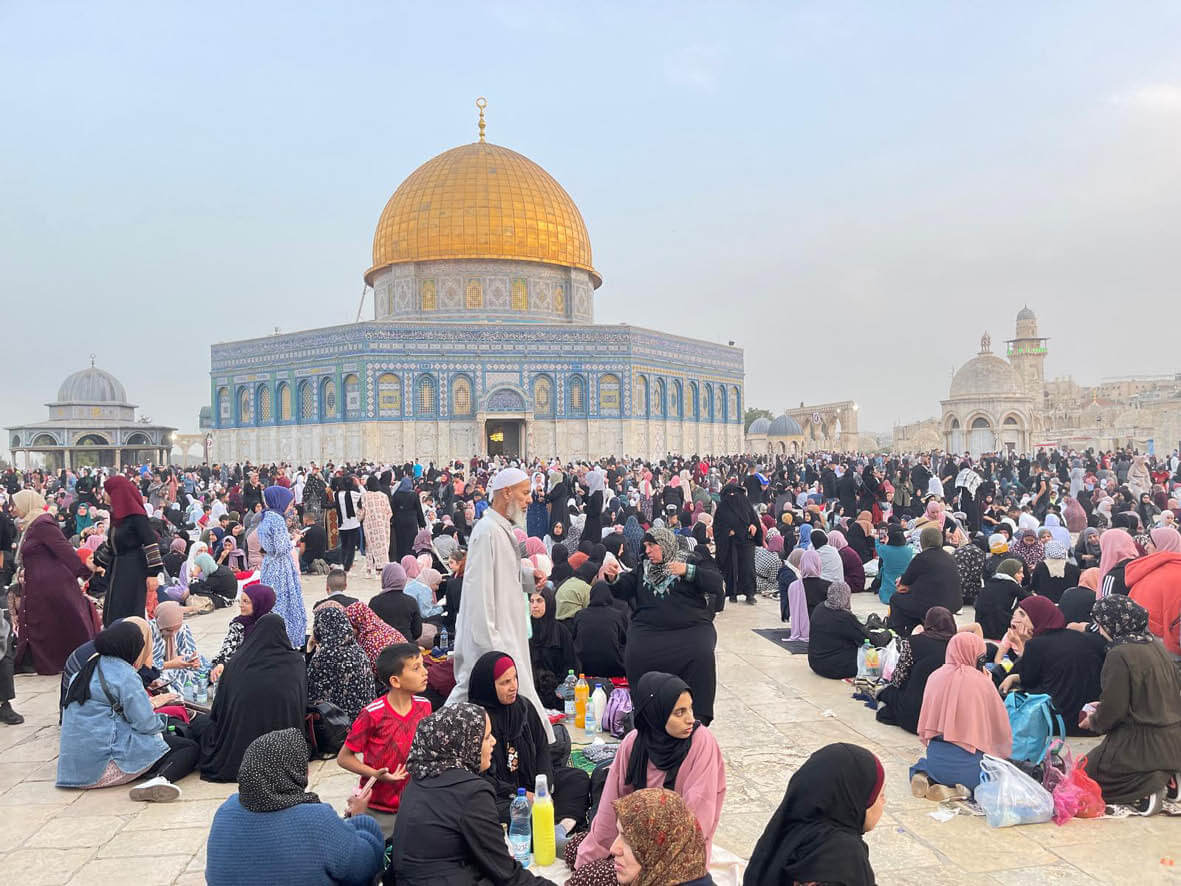
In Madinat Beit al-Maqdis, legend, myth, and ritual meet. In Muslim narratives, Jerusalem was known as the first direction of prayers in the formative years of Islam, the focal point of the miraculous Night Journey, and one of three mosques to which pilgrimage is enjoined by the Prophet Muhammad. In Muslim theology, Jerusalem stands as the axis mundi and a point of connection between heaven and earth.
Because of its centrality in Muslim thought, Jerusalem serves as a definitive image and the symbol of a sacred place parallel to Mecca and Medina. The basis of Beit al-Maqdis’s sanctity reflects hierophany – to use a concept favored by Mircea Eliade – which refers to the eruption of the sacred. The rock beneath the spectacular Dome of the Rock assumed its centrifugal symbolic character as witness to the Night Journey. During this journey, the Prophet is believed to have received from Allah the command to perform the five daily prayers (salat), which all Muslims are required to perform. Upon his return to Mecca, the Prophet established these prayers. It is important to note that he designated Jerusalem as the qibla, the direction Muslims face when praying. Jerusalem is therefore called Ula al-Qiblatain (the First Qibla).
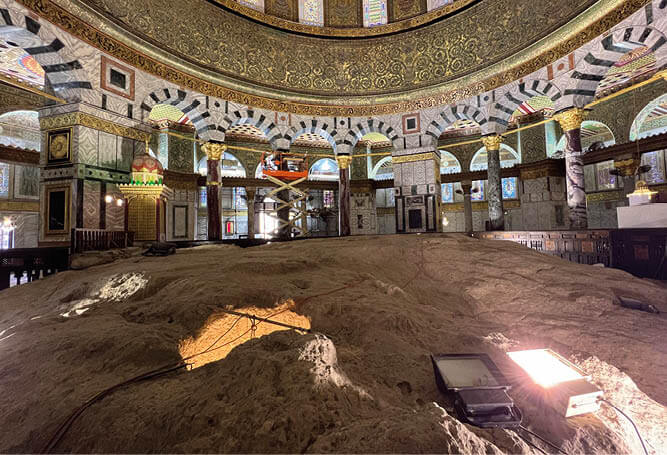
From an Islamic theological perspective, Jerusalem, as the first Qibla (direction of prayer) and land of the Abrahamic prophets, an extensive litany of biblical figures and prophets that includes Abraham, Solomon, David, and Jesus, among others, is a teleologically Muslim city. Its “opening” is not viewed as the occupation of a foreign territory but as a liberation from the perceived instability of the Byzantine-Persian wars and the introduction of a divinely ordained system of justice. The most significant symbol of this transfer of power is the Covenant of Omar (Al-’Uhda al-’Omariyya), a document that guaranteed the Christian residents security for their lives, property, freedom of religious practice, and the protection of their churches.
Jerusalem had assumed its Muslim theological significance decades before its liberation from Roman occupation. During the month of Rajab in the year 620 CE, almost one-and-a-half years before Prophet Muhammad’s hijra (migration) from Mecca to Medina, the symbolic event of Isra and Mi’raj (Night Journey and Ascension) occurred. Whereas the horizontal voyage to Jerusalem is referred to as Al-Isra’, the vertical ascension to heaven is called Al-Mi’raj. That night, according to the Qur’an, God blessed the Rock and its environs. Blessed and sanctified by God (الذي باركنا حوله), the rock assumed a new identity as the “Holy Rock” (الصخرة المقدسة). There is, however, one essential point to bear in mind: namely, that the Night Journey serves as an expression of every Muslim’s deep devotion and spiritual connection to Prophet Muhammad and Jerusalem, and as a confirmation of Mecca’s spiritual and symbolic link with Jerusalem.
A central point of spiritual convergence and contention in Jerusalem is the Haram al-Sharif, and specifically the “Sacred Rock” at its heart. Comparative religion highlights that this site was revered long before the rise of Judaism or Islam. The Canaanites referred to their sanctuary there as juron, a word denoting a threshing floor or a sacred high place linked with divine manifestation (theophany). This pre-Abrahamic sanctity was adopted and transformed by subsequent faiths. In the Jewish tradition, Mount Moriah became the site of the binding of Isaac and the location of the First and Second Temples. In the Islamic tradition, this same site, referred to as al-sakhra al-musharrafa, is the point from which the Prophet Muhammad ascended to heaven during his miraculous Night Journey (Isra’ and Mi’raj).
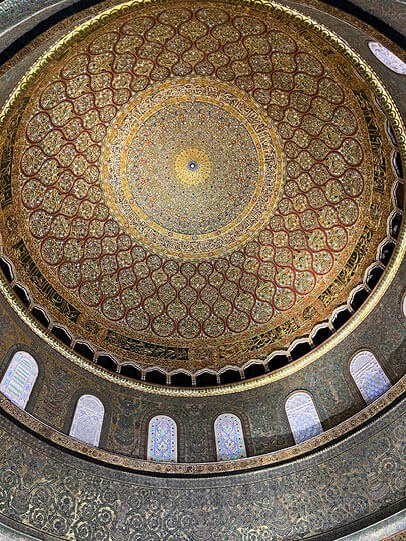
This continuity demonstrates how different religions have layered their narratives and rituals onto the same sacred space, turning the site into an axis mundi within the Muslim hermeneutic – a cosmic center where heaven and earth meet. The physical reality of the site, now enshrined under the Golden Dome, is a testament to this ongoing process of shared sacralization and adaptation.
Muslim historiography and ethnographic research suggest that modern Palestinians are heirs to a complex and varied genetic and cultural legacy, claiming neither racial genetic purity nor ontological cultural homogeneity. While academic biblical study tends to indicate the deep cultural and historical overlaps with Jewish and Christian narratives, the contemporary political identity operates on a different, political level. The modern, native discourse provides narratives of Palestinian identity as “Muslim” and “pure Arab” or “Christian,” shaping their position vis-à-vis the world. The contemporary political ethnic identity as “Palestinian Arab” represents a historical reality that exists alongside the multilayered historical record, demonstrating that identity is a dynamic construct shaped by both deep history and immediate political context.
The history of Jerusalem and Palestine is a continuous narrative battleground. The language we use – whether it is conquest or fath, Canaanite juron or Islamic sakhra – carries significant implications for modern claims of sovereignty and identity. A critical academic approach must navigate these competing narratives, acknowledging the subjective nature of historical memory and the enduring power of place in shaping human identity across millennia.

Dr. Ali Qleibo is an artist, author, and anthropologist. Born in Jerusalem and educated in the United States, his books and artwork have taken him all over the world. Dr. Qleibo has lectured and held senior positions at Al-Quds University, conducted a fellowship at Shalom Hartman Institute, and served as a visiting professor at Tokyo University for Foreign Studies and Kyoto University in Japan. At The Jerusalem Research Center, Dr. Qleibo developed the Muslim tourism itinerary in Jerusalem, encompassing tangible and intangible heritage. A specialist in Palestinian social history, he has authored the books Surviving the Wall, Before the Mountains Disappear, Jerusalem in the Heart, and Mamluk Architectural Heritage in Jerusalem and published a plethora of articles locally and internationally.
