


By Omar Da’na
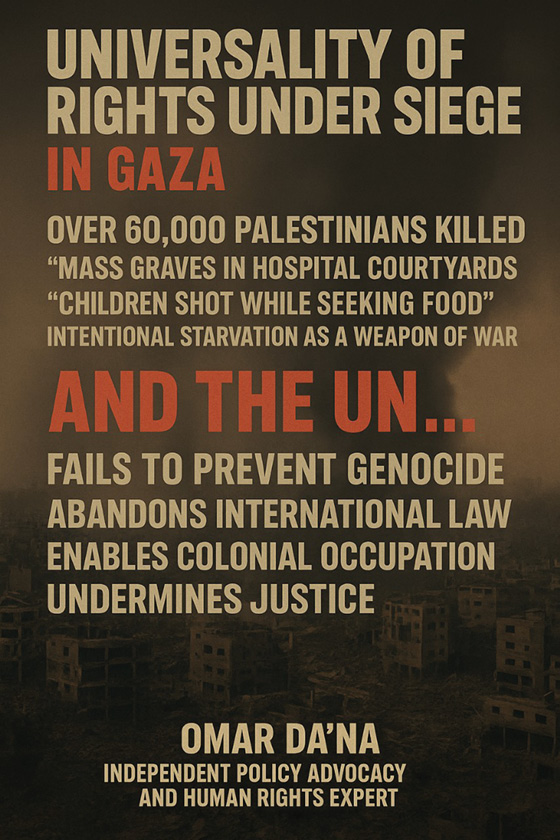
The United Nations was founded on the ashes of World War II, pledging “Never Again” to genocide and enshrining the universality of human rights. Seventy-five years later, Gaza has become the graveyard of those promises. Entire neighborhoods have been obliterated. More than 65,000 Palestinians have been killed since October 2023, tens of thousands of them women and children. UN aid workers describe appalling, inhuman conditions: families digging loved ones from rubble, hospitals converted into mass graves, and civilians shot while searching for food. “This is not humanitarian failure, it is intentional starvation, a weapon of war, prohibited under international law, yet deployed in plain sight with the world watching,” one UN worker wrote.1
The disconnect between the UN’s ideals and its practice in Palestine is stark as UN personnel who speak truth to power face retaliation. In June 2025, Jonathan Whittall, a senior humanitarian official, described how starving civilians were being shot while trying to reach food, only to be informed that his visa in Israel would be revoked. Secretary-General António Guterres himself pointed out that the Security Council’s paralysis over Gaza had damaged the credibility of the organization as a whole, exposing an outdated and unfair system of global security2 that has been captured by the states that can yield their veto power.
The UN’s failures regarding Palestine date back to its very beginnings. In 1947, the General Assembly voted for the partition of the country, sparking war and the Nakba (lit. catastrophe), when in 1948 over 750,000 Palestinians were expelled or fled and hundreds of villages were destroyed. UN Resolution 194 promised their right of return – not a unique right but rather universally applicable to refugees and displaced people, enshrined in international law3 – yet this principle has never been enforced in Palestine. The refugees of 1948 and their descendants remain scattered in exile, many still holding deeds and keys to homes they have never been allowed to see again.
For Palestinians, the UN’s ideals are abstract principles that have failed to deliver justice: broken promises and daily betrayals, written in rubble, starvation, and graves.
Count Folke Bernadotte, the UN’s first mediator in Palestine, advocated for refugee return and international protection for Jerusalem. For his commitment, he was assassinated in Jerusalem in 1948 by a Zionist militia. His murder set an ominous precedent: efforts to uphold Palestinian rights would be violently opposed, and often abandoned by the international community.
In 1949, the UN created the United Nations Relief and Works Agency (UNRWA) to provide temporary relief. Yet seventy-five years later, UNRWA still serves 5.9 million refugees across Gaza, the West Bank, Jordan, Lebanon, and Syria. Refugee camps have become permanent cities of exile. While UNRWA has been a lifeline – described by Guterres as “the backbone of humanitarian support to Gaza”4 – its existence is also a symbol of the international community’s failure to resolve the refugee question. The persistence of UNRWA underscores the contradiction at the heart of the UN’s engagement: it has kept Palestinians alive, but it has not protected their rights or ended their dispossession.
The June 1967 Six-Day War was another turning point, when Israel’s occupation of the West Bank, Gaza, and East Jerusalem created what is now the longest military occupation in modern history. Security Council Resolution 242 called for withdrawal and affirmed the “inadmissibility of acquiring territory by war,” but Israel has evaded compliance. Instead, it has moved its citizens as settlers into the occupied territory. Decade after decade, the Security Council has condemned Israeli settlements and declared them illegal. Resolution 465 in 1980 unanimously affirmed that settlements had “no legal validity.” Yet there has been no enforcement.
Meanwhile, apartheid South Africa faced boycotts, embargoes, and eventual collapse under global pressure. The double standard was glaring: In South Africa a racist regime was dismantled, yet in Palestine, another racist system has become entrenched. For many in the Global South, this hypocrisy has been searing. In 1975, the General Assembly declared “Zionism is a form of racism,” but under intense US pressure, that resolution was revoked in 1991. By then, Israel had deepened its occupation, fortified its settlement enterprise, and entrenched a system many now openly describe as apartheid.
The Oslo Accords of the 1990s promised a two-state solution but delivered entrenchment of the occupation instead, and again, the international community has failed to demand that Israel abide by its commitments. The Palestinian Authority was created, but without sovereignty. Discussions on the refugees’ rights, the status of Jerusalem, and the question of how to deal with the illegal settlements were deferred. By the early 2000s, disillusionment over the lack of progress toward Palestinian statehood erupted in the Second Intifada. While the UN had endorsed Oslo, in 2002 it ceded diplomacy to the “Quartet,” the four states tasked with overseeing the mediations in the so-called peace process even though their leanings were anything but impartial. Aid flowed to build Palestinian institutions, but settlements expanded at record pace and a separation wall was implemented, separating Palestinian communities and impeding Palestinian freedom of movement with significant impact on livelihoods and the economy. In 2004, the International Court of Justice ruled Israel’s West Bank separation wall illegal and ordered its dismantlement, yet Israel has ignored the ruling; the wall has become permanent. Once again, the UN’s moral authority was undermined by its inability to enforce its own legal framework.
From the partition and the Nakba to today: Palestine’s history is a history of abandonment.
Since 2007, Gaza has been under a blockade, with its 2.3 million residents confined in what UN officials and others have long called an open-air prison. Wars in 2008–09, 2012, 2014, and 2021 killed thousands. The UN dispatched fact-finding missions: the Goldstone Commission in 2009, inquiries in 2014, and an open-ended Commission of Inquiry in 2021. Each documented war crimes. Each urged accountability. Yet each was ignored or buried under political pressure.
The war waged since 2023 has been the deadliest. Following Hamas’ attack of October 7 killed 1,200 Israelis, Israel has unleashed unprecedented bombardment. By mid-2025, more than 60,000 Palestinians were dead. UNICEF has reported thousands of children killed, UN Women has reported that two mothers have been dying every hour,5 starving civilians have been shot dead in the hundreds as they approached food trucks, and CEDAW declared that when mothers in Gaza bury nearly 8,000 children in four months, “very basic principles are challenged.”6 While Israel claims to target fighters, civilians have been four-fifths of the casualties.
Moreover, the targeted destruction of civil institutions, media offices, even hospitals and churches has included UN institutions in Gaza – a war crime according to international law. UNRWA facilities have been bombed even though they were clearly marked, convoys have been obstructed, and over 200 UN staff have been killed. Whittall called Gaza “an insurmountable obstacle course of obstructionism.”7 Yet the Security Council, paralyzed by US vetoes, could not demand a ceasefire until 21 months into the war. The General Assembly stepped in, voting overwhelmingly for a humanitarian truce. Israel ignored it.
The Oslo Accords provided no more than a mirage of peace
Warnings of genocide came swiftly. In November 2023, seven UN Special Rapporteurs declared Palestinians faced a “grave risk of genocide.”8 Some officials resigned, saying that genocide was unfolding “before our eyes”9 yet they were unable to prevent any of it. Indeed, the killing goes on unimpeded even though 153 states have signed on to the UN Convention on the Prevention and Punishment of Genocide.
The ICJ delivered two critical interventions. In July 2024, its advisory opinion declared Israel’s occupation unlawful and ordered its end “as rapidly as possible.”10 In a separate case brought by South Africa, the Court issued binding orders requiring Israel to prevent genocidal acts and allow humanitarian aid into the Strip. Israel has ignored both. The contrast with Ukraine is glaring. When Russia invaded, the UN and Western powers mobilized sanctions, weapons, and prosecutions. When Israel razed Gaza, those same powers armed it. International law, Palestinians noted, was only as strong as the politics behind it.
Feminist voices have sharpened the critique. Palestinian and Global South feminists asked: How can a feminism that cannot name genocide be feminism at all? UN Women has been criticized for focusing on menstrual kits while avoiding condemnation of mass killings. “What is genocide but patriarchy writ large – masculinity drunk on its power to dominate and obliterate?” wrote Mona Eltahawy.11 For Gaza’s women, bombs that collapsed maternity wards were not collateral damage, they were gender-based violence. A genuine feminism must confront militarism, apartheid, and colonialism as inseparable from women’s oppression. This critique has exposed a broader hypocrisy: Western institutions celebrate women’s empowerment in principle but are silent when women and children are being slaughtered in Gaza. True intersectional feminism requires naming genocide, apartheid, and occupation as gendered violence.
The Global South and the global streets do not mirror the stance of Western governments. As Gaza burned, millions marched worldwide. In Johannesburg, Jakarta, London, New York, and beyond, people demanded a ceasefire and accountability. Angela Davis called Palestine “the moral litmus test for the world.” For many activists, Palestinian liberation is inseparable from struggles against racism, climate injustice, and patriarchy. Global South leaders have echoed this sentiment. South Africa’s government led the genocide case at the ICJ. Brazil, Ireland, Chile, and others demanded accountability. Across Latin America and Africa, governments drew parallels between their colonial histories and Palestine’s plight. The message was clear: Palestine is not a marginal issue. It is a test of whether the international system truly values universality.
Palestinians often stress that they have been waiting their entire lives for the international community and its institutions to deliver justice. For them, the UN is an institution that provides aid but not protection, documents their suffering but cannot stop it. Yet history does not have to be fixed. The UN has three tools at its disposal that it rarely uses: The Uniting for Peace resolution could bypass Security Council paralysis; Israel’s membership privileges could be suspended, as the UN did with apartheid South Africa; and the international community could enforce ICJ rulings through coordinated state action.
Gaza is the graveyard of international law. There are no systems of accountability in place, and the United States, as the strongest power worldwide, has wielded its veto at least 53 times to shield Israel from accountability, going as far as repeatedly blocking measures that called for a ceasefire.
Above all, the UN must name the crimes: settler colonialism, apartheid, genocide. In the struggle against South Africa, the UN did not mince words. Why not now? Independent experts such as Francesca Albanese have described Israel’s actions as genocide and colonial erasure. For her truth-telling, she was sanctioned by the United States. The message is chilling: clarity comes at a cost. Such efforts at silencing voices that call for justice must be confronted.
The path forward toward justice exists. It comprises accountability that can be achieved by supporting ICC investigations, imposing arms embargoes, and sanctioning war criminals. It furthermore should offer protection by deploying international observers or peacekeepers to shield civilians. Another important measure is inclusion that centers Palestinian voices, especially women, youth, and refugees, in all processes. And finally, it involves consistency: we must apply international law equally, whether in Ukraine or Gaza. These steps are not radical. They are already outlined in decades of UN reports. What has been missing is the political will to implement them.
The UN must also confront its own complicity and reimagine its role. Too often, its statements lament “tragic deaths” without naming perpetrators. This reduces massacres to natural disasters, stripping victims of dignity. For the UN to redeem itself, it must moreover confront the veto abuse, particularly by the United States, amplify Global South leadership, and integrate grassroots activism into diplomacy. Decolonizing the UN means centering refugees’ rights, feminist perspectives, and civil society. It also means resisting donor pressure that muzzles agencies like UNRWA.
The South African struggle against apartheid shows the way: Sanctions, boycotts, truth-telling, and unwavering commitment to equality eventually dismantled a racist regime. Palestinians deserve no less. In 2023, UN experts warned, “A genocide is unfolding before our eyes, and the Security Council’s paralysis is shameful. History will not forgive our failure.”12 The UN now stands at a crossroads. One path is the continuation of the status quo – issuing reports, adopting resolutions, and delivering more or less sufficient amounts of aid while Palestinians bleed – and the UN’s credibility collapses. The other path is principled action: confronting impunity, enforcing international law, and recognizing Palestine’s struggle as the last great anti-colonial cause.
If the UN cannot uphold universality in Gaza, universality itself collapses. If it can, even belatedly, it may redeem its founding promise. For Palestinians, justice delayed has been the story of generations. The question is whether justice will finally be delivered – or buried beneath Gaza’s rubble.
Omar Da’na is an independent policy advocacy and human rights expert with over 20 years of experience in the Middle East and North Africa. He has led national, regional, and global advocacy initiatives and specializes in international law, human rights education, and humanitarian policy.
1 Whittall, Jonathan, “I Saw Many Atrocities as a Senior Aid Official in Gaza. Now Israeli authorities are trying to silence us.” Guardian, July 29, 2025. Whittall’s firsthand account of humanitarian operations in Gaza and the retaliation he faced.
2 “UN Head Slams Security Council for Failure to End Gaza, Sudan, Ukraine Wars,” Al Jazeera, September 13, 2024.
3 The right of return is based, among others, on the Article 13 of the 1945 Universal Declaration of Human Rights. See also, “Human Rights Watch Policy on the Right of Return,” no date.
4 Guterres, António, “UN Secretary-General interview with Al Jazeera on Security Council Failures and Impunity,”
September 13, 2024.
5 UNICEF, Gaza Has Become a Graveyard for Thousands of Children – UNICEF warns of a “lost generation,”
press release, February 2024.
6 UN Women, Two Mothers Are Killed in Gaza Every Hour, press release, January 2024.
7 Whittall, Jonathan, I Saw Many Atrocities as a Senior Aid Official in Gaza, Guardian, July 29, 2025.
8 OHCHR, “UN Experts Warn of Grave Risk of Genocide in Gaza,” Office of the High Commissioner for Human Rights, November 16, 2023.
9 UN OHCHR/UN Experts, “’’A Genocide Is Unfolding Before Our Eyes,’ – UN Experts Warn, Some Resign in Protest over Gaza Crisis, Office of the High Commissioner for Human Rights, November 2023.
10 International Court of Justice, “Advisory Opinion on the Legal Consequences Arising from the Policies and Practices of Israel in the Occupied Palestinian Territory, Including East Jerusalem,” ICJ, The Hague, July 19, 2024.
11 UN Women, “Two Mothers Are Killed in Gaza Every Hour,” press release, January 2024, Mona Eltahawy, “Feminism vs. Genocide,” Feminist Giant, 2024.
12 OHCHR, UN Experts Warn: “A Genocide Is Unfolding Before Our Eyes” – Security Council Paralysis Is Shameful,
Office of the High Commissioner for Human Rights, November 16, 2023.
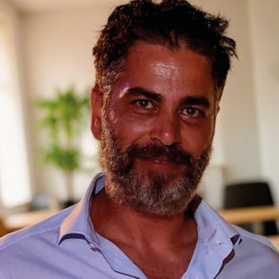
Omar Da’na is an independent policy advocacy and human rights expert with over 20 years of experience in the Middle East and North Africa. He has led national, regional, and global advocacy initiatives and specializes in international law, human rights education, and humanitarian policy.
