


By Terry Ahwal
From dusk till dawn, no matter where we reside and no matter our age, gender, or religion, we formulate our personal prayers, religious or secular, to grant the people of Gaza and our homeland an end to their suffering. Although our connection to our brothers and sisters is unshakable, we know that thoughts and prayers are not enough. From the second we wake up until the moment we go to sleep, or try to, we navigate the news about what’s going on in Gaza and the West Bank.
For those of us in exile, the voices of Gaza’s children and suffering elders echo in the deepest parts of our hearts. We feel their pain in our veins. As their anguished voices reverberate in our ears, we work around the clock to stop their murderous tormentors by leveraging all our creativity and resourcefulness. Our efforts to support our homeland did not start in October 2023. We have never stopped working to create awareness of the injustice of Palestinian dispossession, we have sometimes slipped into complacency. The Palestinians of the occupied territories have woken us from our privileged slumber and moved us to unprecedented levels of action.
The steadfastness and courage of the people of Gaza have given us the energy to rediscover our struggle for self-determination. And for the first time since the Nakba, our collective actions are creating waves of positive change in our adoptive country of America. At all levels, we have become ambassadors for our cause, seizing every opportunity to amplify Israel’s genocidal campaign in Gaza and the expanding level of atrocities in the West Bank.
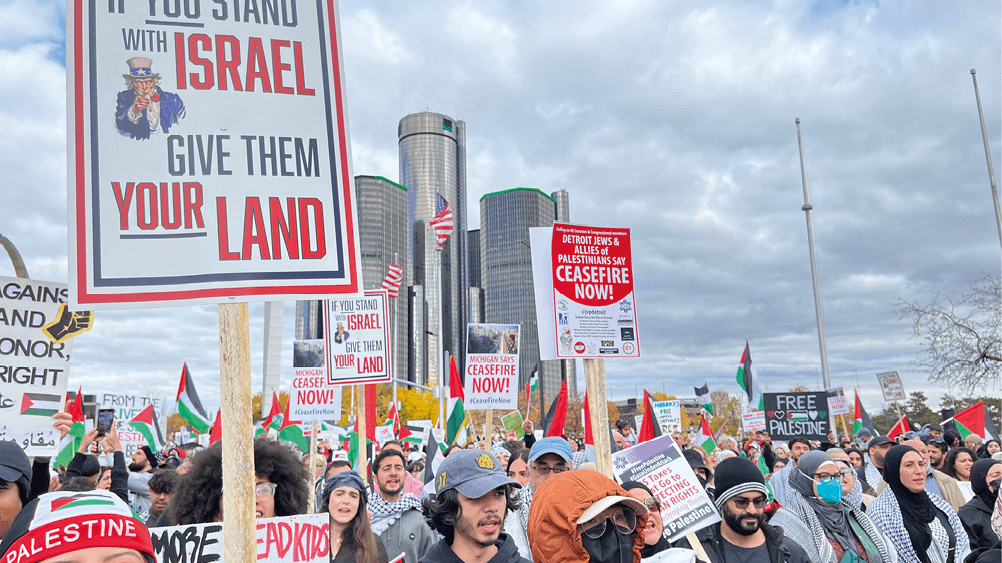
Led by our fearless and more astute younger generations, we have taken to the streets and social and traditional media to expose Israel’s crimes in real time. We have used our numbers strategically to mobilize people in traditionally blue states to send our message of disgust to politicians who are complicit in the genocidal crimes against our people, including the sitting president.
During 2023, prior to the Israeli assault on Gaza, Palestinian organizations and individuals met with all 535 members of the US Congress and their staff, as well as with key people in administrative offices as part of our routine advocacy work. Our meetings sought to counter renewed educational campaigns to further sway the trajectory of American policy in favor of Israel. We made some progress, but it was not enough. Our voices were muffled by a corrupt racist system manipulated by the power of money, corporate greed, and military might. But our power and energy was revitalized as we watched – both in horror and admiration – the determination and will of the people of Gaza, including the brave journalists, medical personnel, women, men, and children, who were defiant in the face of death. We mobilized together, confronted our detractors, and demanded to be heard.
Taking a page from successful civil rights activists, Palestinian solidarity organizers have staged protest actions in a number of cities and states throughout the country. After many years of careful coalition building and organizing, Students for Justice in Palestine on American university campuses were quickly able to launch coordinated campaigns of protest actions, including sit-ins, hunger strikes, and teach-ins in numerous locations. We built strong coalitions committed to peace based on justice for Palestine. We engaged with students, staff, professors, and administrators to explain the root causes of the Palestinian tragedy, promote Palestinian culture, and neutralize the accusations of antisemitism that were hurled at us.
Despite uphill battles, we have challenged our institutions to rethink their biases on the Palestinian-Israeli issue and demanded action. We have been targeted by the pro-Israeli opposition who tried to silence us but we have pushed back. Many students have risked their present and future careers to stand with Gaza, organizing rallies and demonstrations. Young Palestinian, Jewish, Arab, Black, Latinos, and other civic- and social-justice-minded college students led and participated in sit-down strikes on campuses. We disrupted congressional hearings, closed city streets, and stopped traffic to highlight the atrocities committed against the Palestinian people with the complicity of the United States and other Western countries. Despite threats, we took inspiration from the courage of the people of Gaza and stood firm and undaunted

Our shared solidarity with Gaza and the Palestinian people brought all Palestinian factions and communities together to maximize our efforts. When students and employees had been targeted by the opposition, organizations such as Pal Legal, the Arab Anti-Discrimination Committee (ADC), and the Arab American Institute (AAI) provided free legal aid to targeted individuals and groups. We sued the US administration, including President Biden, and threatened employers and institutions with liability charges. We built a system of action and response to events in real time. As our sole mission in life became Palestine, experts gave us tools to disseminate our messages skillfully and effectively to maintain momentum.
We now see an unprecedented level of activism in the United States. Young and old, students and teachers, rich and poor are coming together to support the Palestinian quest for justice and freedom. Those who are not able to actively demonstrate donate money to humanitarian efforts. Nonprofit organizations are inundated by people who want to donate for Gaza. Children ask their parents to donate money to Gaza in lieu of birthday or holiday gifts. Families whose children are getting married ask their guests to give to Gaza instead of gifting the newlyweds.
As images of destruction began to appear on our mobile devices, organizations like the American Federation of Ramallah Palestine (AFRP), Al Bireh, Beit Hanina, Deir Dibwan,, Jifna, and other communities reached out to their members for additional donations. To date, the AFRP has raised $500,000 for medical missions in Palestine. This is in addition to the $6 million raised for the Ramallah hospital and the $5 million allocated to build a home for senior citizens in Ramallah. In my circle of family and friends in Michigan, not a day goes by without their thinking and doing something for the Palestinian people. As soon as the Israeli army began bombing Gaza, Father Alex K., a Franciscan friar, reached out to his congregation to ask for help. Within weeks, he raised over $30,000. Father Bill T. called me in tears as the massacres unfolded on screen. His parishioners donated $20,000 and are still donating.
Nonprofits like the Palestine Children’s Relief Fund (PCRF) have activated their emergency response teams to raise funds and recruit medical volunteers. Many of our medical professionals are donating their skills, traveling to Gaza and the West Bank, Egypt, and Jordan to help injured Palestinians from Gaza. They are using their vacation time, risking their jobs, and sometimes their lives, to provide lifesaving medical treatments. Lawyers and legal experts do pro bono work to support South Africa’s submission to the International Court of Justice. Families are opening homes for injured Palestinian children sent to the United States for medical treatment. Churches, mosques, and temples throughout the United States are holding food and fundraising drives, and the Knights of the Holy Sepulcher have pledged to raise millions of dollars to help teachers and employees who have lost their jobs due to the Israeli occupation.
Our savvy social media influencers have brought the Israeli crimes against the Palestinian people into every household. They are using their platforms to show the tragedy in real time. Gigi and Bella Hadid, and their cousin Lina, daily – and unapologetically – expose millions of their followers, including movie and television stars, to the Palestinians’ plight. More than 500 sympathetic federal government employees have written letters to the president stating their dissatisfaction with government policy towards Gaza. Some, like Tareq Habbash, a political appointee at the Department of Education, have resigned to protest the Biden administration’s enabling and funding of Israel’s assault on Gaza, which is now universally recognized as genocide.
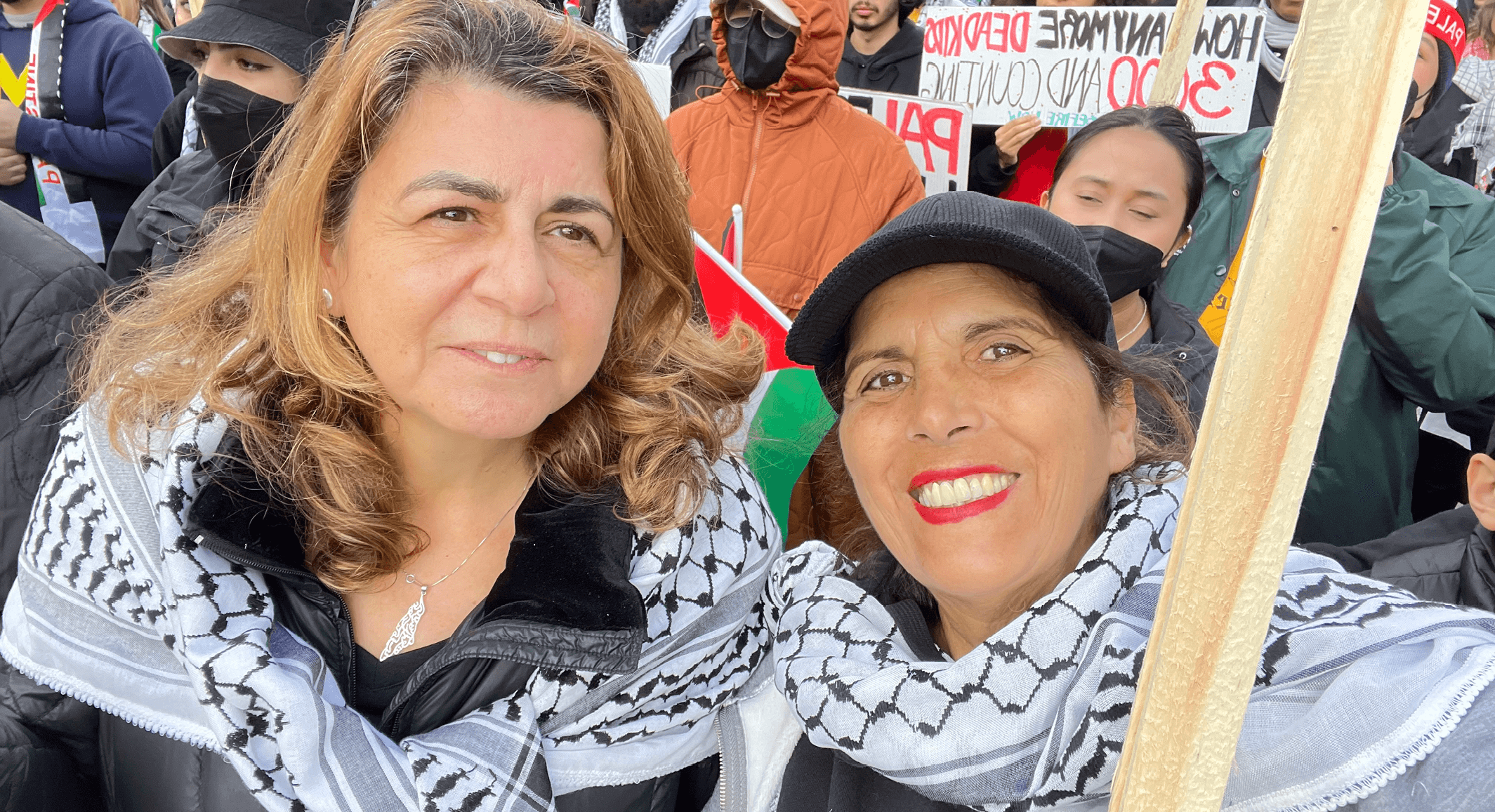
In the recent Democratic primary elections in Michigan, more than 25 elected officials endorsed the campaign to encourage voters to cast ballots for “uncommitted” – essentially no one – as a protest against the war in Gaza and to demand a ceasefire. The majority of Arab voters in Hamtramck, Michigan, voted uncommitted during the recent Democratic primary, defeating Biden. Although symbolic, these actions have created a storm that the Biden campaign cannot simply ignore. We not only declined a meeting with the president, we also publicized our disdain for his unwavering commitment to Israel and demanded a change in course. Like the people of Gaza, we are no longer afraid. We found our power in our collective work with others of like mind and continue to work to bring justice to our suffering people in Palestine.
In this time of adversity and horror, we have found our voice to support the people of Palestine battling the stranglehold of settler-colonial apartheid. We have redeemed the deliberately obfuscated narratives of the Nakba and have disrupted the status quo, exposing the veneer of US civilization. We have become the building blocks of a new era, where the victims are regaining their voices and being heard. We will not rest until Palestine is free. And ultimately, we are humbled by the courage of our martyrs and by the steadfastness of our people who continue to live their lives and to resist inside Palestine.
